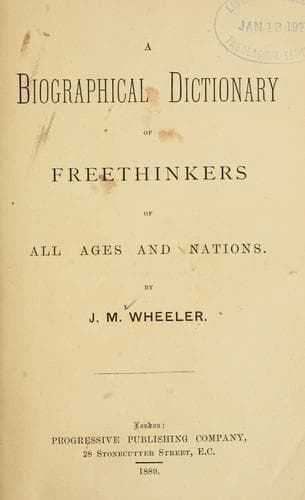
A Biographical Dictionary of Freethinkers of All Ages and NationsWheeler, J. M. (Joseph Mazzini)
Religion
A Biographical Dictionary of Freethinkers of All Ages and Nations
Wheeler, J. M. (Joseph Mazzini)
Free thought -- Biography
Amaury or Amalric de Chartres, a heretic of the thirteenth century,
was a native of Bene, near Chartres, and lived at Paris, where he gave
lessons in logic. In a work bearing the title of Physion, condemned
by a bull of Pope Innocent III. (1204), he is said to have taught a
kind of Pantheism, and that the reign of the Father and Son must give
place to that of the Holy Spirit. Ten of his disciples were burnt at
Paris 20 Dec. 1210, and the bones of Amaury were exhumed and placed
in the flames.
Amberley (John Russell) Viscount, eldest son of Earl Russell,
b. 1843. Educated at Harrow, Edinburgh and Trinity College,
Cambridge, where ill-health prevented him reading for honors. He
entered Parliament in 1866 as Radical member for Nottingham. Lord
Amberley contributed thoughtful articles to the North British,
the Fortnightly and Theological Reviews, and will be remembered by
his bold Analysis of Religious Belief (1876), in which he examines,
compares and criticises the various faiths of the world. Lord Amberley
left his son to be brought up by Mr. Spalding, a self-taught man of
great ability and force of character; but the will was set aside, on
appeal to the Court of Chancery, in consideration of Mr. Spalding's
heretical views. Died 8 Jan. 1876.
Amman (Hans Jacob), German surgeon and traveller, b. Lake Zurich
1586. In 1612 he went to Constantinople, Palestine and Egypt, and
afterwards published a curious book called Voyage in the Promised
Land. Died at Zurich, 1658.
Ammianus (Marcellinus). Roman soldier-historian of the fourth century,
b. at Antioch. He wrote the Roman history from the reign of Nerva to
the death of Valens in thirty-one books, of which the first thirteen
are lost. His history is esteemed impartial and trustworthy. He served
under Julian, and compares the rancor of the Christians of the period
to that of wild beasts. Gibbon calls him "an accurate and faithful
guide." Died about 395 A.D.
Ammonius, surnamed Saccas or the Porter, from his having been obliged
in the early part of his life to adopt that calling, was born of
Christian parents in Alexandria during the second century. He,
however, turned Pagan and opened a school of philosophy. Among his
pupils were Origen, Longinus and Plotinus. He undoubtedly originated
the Neo-Platonic movement, which formed the most serious opposition
to Christianity in its early career. Ammonius died A.D. 243, aged
over eighty years.
Anaxagoras, a Greek philosopher of the Ionic school, b. about 499 B.C.,
lived at Athens and enjoyed the friendship of Pericles. In 450 B.C. he
was accused of Atheism for maintaining the eternity of matter and was
banished to Lampsacus, where he died in 428 B.C. It is related that,
being asked how he desired to be honored after death, he replied,
"Only let the day of my death be observed as a holiday by the boys
in the schools." He taught that generation and destruction are only
the union and separation of elements which can neither be created
nor annihilated.
Public-domain text, read in full here on John Shaqi.
Reviews
Reviews
No reviews yet
Be the first to share your thoughts on this work.
Join the Discussion
Join the discussion
Sign in to leave a comment or review.
Sign InorCreate an account