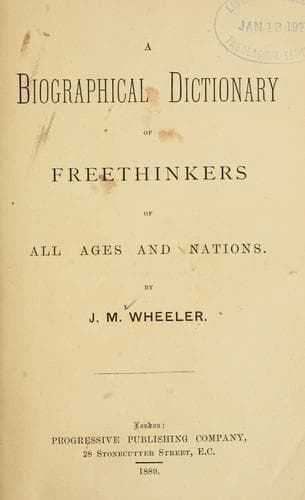
A Biographical Dictionary of Freethinkers of All Ages and NationsWheeler, J. M. (Joseph Mazzini)
Religion
A Biographical Dictionary of Freethinkers of All Ages and Nations
Wheeler, J. M. (Joseph Mazzini)
Free thought -- Biography
Frauenstaedt (Christian Martin Julius), Dr., philosopher and disciple
of Schopenhauer, b. 17 April, 1813, at Bojanowo, Posen. He studied
philosophy and theology at Berlin, but meeting Schopenhauer at
Frankfort in '47 he adopted the views of the pessimist, who made
him his literary executor. Among Frauenstädt's works are Letters on
Natural Religion, '58, The Liberty of Men and the Personality of God,
'38; Letters on the Philosophy of Schopenhauer, '54, etc. Died at
Berlin, 13 Jan. 1879.
Frederick II. (Emperor of Germany), the greatest man of the thirteenth
century and founder of the Renaissance, b. 26 Dec. 1194. Was elected
to the throne in 1210. He promoted learning, science, and art, founded
the Universities of Vienna and Naples, had the works of Aristotle
and Averroes translated, and was the patron of all the able men of
his time. For his resistance to the tyranny of the Church he was
twice excommunicated. He answered by a letter attacking the Pope
(Gregory IX.), whom he expelled from Rome in '28. He made a treaty
with the Sultan of Egypt, by which he became master of Jerusalem. For
some heretical words in his letter, in which he associates the names
of Christ, Moses, and Mohammed, he was reported author of the famous
work De Tribus Impostoribus. He addressed a series of philosophical
questions to Ibn Sabin, a Moslem doctor. He is said to have called
the Eucharist truffa ista, and is credited also with the saying
"Ignorance is the mother of devotion." Died at Florence, 13 Dec. 1250.
Frederick the Great (King of Prussia), b. 24 Jan. 1712, was educated in
a very rigid fashion by his father, Frederick William I. He ascended
the throne and soon displayed his political and military ability. By
a war with Austria he acquired Silesia. He wrote several deistical
pieces, and tolerated all religions and no religion saying "every man
must get to heaven his own way." He attracted to his court men like
Lamettrie, D'Argens, Maupertuis, and Voltaire, who, says Carlyle,
continued all his days Friedrich's chief thinker. In 1756 France,
Austria, Sweden, and Russia united against him, but he held his own
against "a world in arms." After a most active life Frederick died
at Potsdam, 17 Aug. 1786. The Philosophical Breviary attributed to
him was really written by Cérutti.
Fredin (Nils Edvard), Swedish writer, b. 1857. Has published
translation of modern poets, and also of Col. Ingersoll's writings. In
'80 he was awarded first prize by the Swedish Academy for an original
poem.
Freeke (William), b. about 1663, wrote A Brief but Clear Confutation
of the Trinity, which being brought before the notice of the House of
Lords it was on 3 Jan. 1693 ordered to be burnt by the common hangman,
and the author being prosecuted by the Attorney General was fined £500.
Public-domain text, read in full here on John Shaqi.
Reviews
Reviews
No reviews yet
Be the first to share your thoughts on this work.
Elsewhere in the archive
Join the Discussion
Join the discussion
Sign in to leave a comment or review.
Sign InorCreate an account