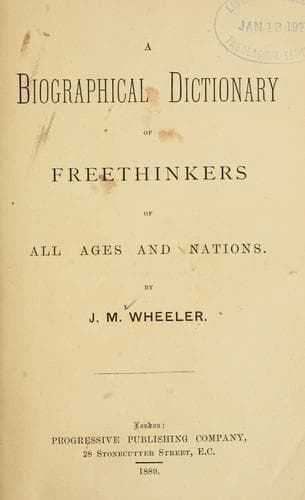
A Biographical Dictionary of Freethinkers of All Ages and NationsWheeler, J. M. (Joseph Mazzini)
Religion
A Biographical Dictionary of Freethinkers of All Ages and Nations
Wheeler, J. M. (Joseph Mazzini)
Free thought -- Biography
"Franchi (Ausonio)," the pen name of Francesco Cristoforo Bonavino,
Italian ex-priest, b. Pegli, 24 Feb. 1821. Brought up in the Church
and ordained priest in '44, the practice of the confessional made
him sceptical and he quitted it for philosophy, having ceased to
believe in its dogmas, '49. In '52 he published his principal work,
entitled The Philosophy of the Italian Schools. The following year
he published The Religion of the Nineteenth Century. He established
La Razione (Reason) and Il Libero Pensiero at Turin, '54-57; wrote
on the Rationalism of the People, Geneva, '56, and became an active
organiser of anti-clerical societies. In '66 he published a criticism
of Positivism, and has since written Critical and Polemical Essays,
3 vols. Milan, '70-72. In '68 was appointed Professor of Philosophy
in the Academy of Milan by Terenzio Mamiani.
Francis (Samuel), M.D., author of Watson Refuted, published by
Carlile, 1819.
Francois de Neufchateau (Nicolas Louis), Count, French statesman,
poet, and academician, b. Lorraine, 17 April, 1750. In his youth he
became secretary to Voltaire, who regarded him as his successor. He
favored the Revolution, and was elected to the Legislative Assembly
in '91. As Member of the Directory, '97, he circulated d'Holbach's
Contagion Sacrée. He became President of the Senate, '14-16. He wrote
numerous pieces. Died at Paris 10 Jan. 1828.
Franklin (Benjamin), American patriot and philosopher, b. Boston 17
Jan. 1706. He was apprenticed to his uncle as a printer, came to
England and worked at his trade '24-26; returned to Philadelphia,
where he published a paper and became known by his Poor Richard's
Almanack. He founded the public library at Philadelphia, and
made the discovery of the identity of lightning with the electric
fluid. He became member of the Provincial Assembly and was sent to
England as agent. When examined before the House of Commons he spoke
boldly against the Stamp Act. He was active during the war with this
country, and was elected member of Congress. Became envoy to France,
and effected the treaty of alliance with that country, 6 Feb. '78,
which secured the independence of the American colonies. Turgot summed
up his services in the fine line Eripuit cælo fulmen, sceptrumque
tyrannis. "He wrested the thunderbolt from heaven and the sceptre
from kings." Died at Philadelphia, 17 April, 1790.
Fransham (John), a native of Norwich, b. 1730, became a teacher of
mathematics, renounced the Christian religion, and professed Paganism,
writing several treatises in favor of disbelief. Died 1810.
Public-domain text, read in full here on John Shaqi.
Reviews
Reviews
No reviews yet
Be the first to share your thoughts on this work.
Elsewhere in the archive
Join the Discussion
Join the discussion
Sign in to leave a comment or review.
Sign InorCreate an account