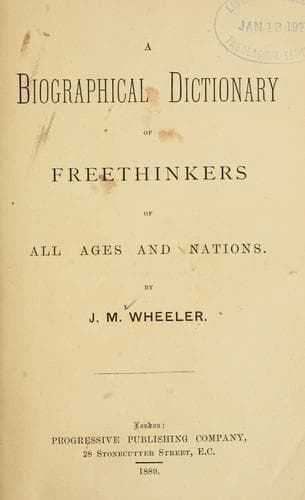
A Biographical Dictionary of Freethinkers of All Ages and NationsWheeler, J. M. (Joseph Mazzini)
Religion
A Biographical Dictionary of Freethinkers of All Ages and Nations
Wheeler, J. M. (Joseph Mazzini)
Free thought -- Biography
Girard (Stephen), American philanthropist, b. near Bordeaux France,
24 May, 1750. He sailed as cabin boy to the West Indies about 1760;
rose to be master of a coasting vessel and earned enough to settle
in business in Philadelphia in 1769. He became one of the richest
merchants in America, and during the war of 1812 he took the whole
of a Government loan of five million dollars. He called his vessels
after the names of the philosophers Helvetius, Montesquieu, Voltaire,
Rousseau, etc. He contributed liberally to all public improvements
and radical movements. On his death he left large bequests to
Philadelphia, the principal being a munificent endowment of a college
for orphans. By a provision of his will, no ecclesiastic or minister
of any sect whatever is to hold any connection with the college, or
even be admitted to the premises as a visitor; but the officers of the
institution are required to instruct the pupils in secular morality
and leave them to adopt their own religious opinions. This will has
been most shamefully perverted. Died Philadelphia, 26 Dec. 1831.
Glain (D. de Saint). See Saint Glain.
Glennie (John Stuart Stuart), living English barrister and
writer, author of In the Morningland, or the law of the origin and
transformation of Christianity, 1873, the most important chapter
of which was reprinted by Thomas Scott, under the title, Christ and
Osiris. He has also written Pilgrim Memories, or travel and discussion
in the birth-countries of Christianity with the late H. T. Buckle,
1875.
Glisson (Francis), English anatomist and physician, b. Rampisham,
Dorsetshire, 1597. He took his degree at Cambridge, and was there
appointed Regius Professor of Physic, an office he held forty years. He
discovered Glisson's capsule in the liver, and was the first to
attribute irritability to muscular fibre. In his Tractatus de natura
substantiæ energetica, 1672, he anticipates the natural school in
considering matter endowed with native energy sufficient to account
for the operations of nature. Dr. Glisson was eulogised by Harvey,
and Boerhaave called him "the most accurate of all anatomists that
ever lived." Died in 1677.
Godwin (Mary). See Wollstonecraft.
Public-domain text, read in full here on John Shaqi.
Reviews
Reviews
No reviews yet
Be the first to share your thoughts on this work.
Elsewhere in the archive
Join the Discussion
Join the discussion
Sign in to leave a comment or review.
Sign InorCreate an account