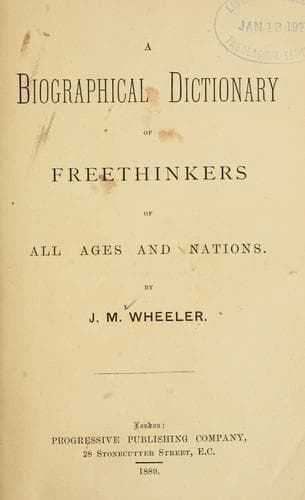
A Biographical Dictionary of Freethinkers of All Ages and NationsWheeler, J. M. (Joseph Mazzini)
Religion
A Biographical Dictionary of Freethinkers of All Ages and Nations
Wheeler, J. M. (Joseph Mazzini)
Free thought -- Biography
Godwin (William), English historian, political writer and novelist,
b. Wisbeach, Cambridgeshire, 3 March, 1756. The son of a Dissenting
minister, he was designed for the same calling. He studied at Hoxton
College, and came out, as he entered, a Tory and Calvinist; but making
the acquaintance of Holcroft, Paine, and the English Jacobins, his
views developed from the Unitarianism of Priestley to the rejection
of the supernatural. In '93 he published his republican work on
Political Justice. In the following year he issued his powerful
novel of Caleb Williams. He married Mary Wollstonecraft, '96; wrote,
in addition to several novels and educational works, On Population,
in answer to Malthus, 1820; a History of the Commonwealth, '24-28;
Thoughts on Man, '31; Lives of the Necromancers, '34. Some Freethought
essays, which he had intended to form into a book entitled The Genius
of Christianity Unveiled, were first published in '73. They comprise
papers on such subjects as future retribution, the atonement, miracles,
and character of Jesus, and the history and effects of the Christian
religion. Died 7 April, 1836.
Goethe (Johann Wolfgang von), Germany's greatest poet,
b. Frankfort-on-Main, 28 Aug. 1749. He records that early in his
seventh year (1 Nov. 1758) the great Lisbon earthquake filled his
mind with religious doubt. Before he was nine he could write several
languages. Educated at home until sixteen, he then went to Leipsic
University. At Strasburg he became acquainted with Herder, who directed
his attention to Shakespeare. He took the degree of doctor in 1771,
and in the same year composed his drama "Goetz von Berlichingen." He
went to Wetzlar, where he wrote Sorrows of Werther, 1774, which at
once made him famous. He was invited to the court of the Duke of
Saxe-Weimar and loaded with honors, becoming the centre of a galaxy
of distinguished men. Here he brought out the works of Schiller and
his own dramas, of which Faust is the greatest. His chief prose work
is Wilhelm Meister's Apprenticeship. His works are voluminous. He
declared himself "decidedly non-Christian," and said his objects of
hate were "the cross and bugs." He was averse to abstractions and
refused to recognise a Deity distinct from the world. In philosophy
he followed Spinoza, and he disliked and discountenanced the popular
creed. Writing to Lavater in 1772 he said: "You look upon the gospel as
it stands as the divinest truth: but even a voice from heaven would not
convince me that water burns and fire quenches, that a woman conceives
without a man, and that a dead man can rise again. To you, nothing is
more beautiful than the Gospel; to me, a thousand written pages of
ancient and modern inspired men are equally beautiful." Goethe was
opposed to asceticism, and Pfleiderer admits "stood in opposition
to Christianity not merely on points of theological form, but to
a certain extent on points of substance too." Goethe devoted much
Public-domain text, read in full here on John Shaqi.
Reviews
Reviews
No reviews yet
Be the first to share your thoughts on this work.
Elsewhere in the archive
Join the Discussion
Join the discussion
Sign in to leave a comment or review.
Sign InorCreate an account