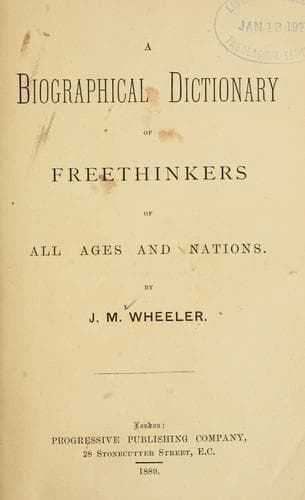
A Biographical Dictionary of Freethinkers of All Ages and NationsWheeler, J. M. (Joseph Mazzini)
Religion
A Biographical Dictionary of Freethinkers of All Ages and Nations
Wheeler, J. M. (Joseph Mazzini)
Free thought -- Biography
Guyau (Marie Jean), French philosopher, b. 1854, was crowned at the
age of 19 by the Institute of France for a monograph on Utilitarian
morality. In the following year he had charge of a course of philosophy
at the Condorcet lycée at Paris. Ill health, brought on by excess of
work, obliged him to retire to Mentone, where he occupied himself
with literature. His principal works are La Morale d'Epicure (the
morality of Epicurus), in relation to present day doctrines, 1878,
La Morale Anglaise Contemporaine (Contemporary English Ethics), '79,
crowned by the Academy of Moral Sciences. Verses of a philosopher,
'81. Esquisse d'une morale sans obligation ni sanction (Sketch of
morality without obligation or sanction,) '84, and L'Irreligion de
l'Avenir (the Irreligion of the Future) '87. M. Guyau was a follower of
M. Fouillée, but all his works bear the impress of profound thought and
originality. A chief doctrine is the expansion of life. Died Mentone,
31 March, 1888.
Guyot (Yves), French writer and statesman, b. Dinan, 1843. He wrote
with Sigismond Lacroix a Study of the Social Doctrines of Christianity,
'73, and a work on morality in the Bibliothèque Matérialiste. Elected
on the Municipal Council of Paris '74-78, he has since been a deputy
to the Chamber, and is now a member of the government. He has written
the Principles of Social Economy, '84, and many works on that topic;
has edited Diderot's La Religieuse and the journals Droits de l'homme
and le Bien public.
Gwynne (George), Freethought writer in the Reasoner and National
Reformer, under the pen-name of "Aliquis." His reply to J. H. Newman's
Grammar of Assent shewed much acuteness. He served the cause both by
pen and purse. Died 25 Sept. 1873.
Gyllenborg (Gustaf Fredrik), Count. Swedish poet, b. 6 Dec. 1731, was
one of the first members of the Academy of Stockholm and Chancellor
of Upsala University. He published satires, fables, odes, etc.,
among which may be named The Passage of the Belt. His opinions were
Deistic. Died 30 March, 1808.
Haeckel (Ernst Heinrich Philipp August), German scientist, b. Potsdam,
16 Feb. 1834; studied medicine and science at Würzburg, Berlin,
and Vienna. In '59 he went to Italy and studied zoology at Naples,
and two years later was made Professor of Zoology at Jena. Between
'66 and '75 he travelled over Europe besides visiting Syria and Egypt,
and later he visited India and Ceylon, writing an interesting account
of his travels. He is the foremost German supporter of evolution; his
Natural History of Creation, '68, having gone through many editions,
and been translated into English '76, as have also his Evolution
of Man, 2 vols. '79, and Pedigree of Man, '83. Besides numerous
monographs and an able work on Cellular Psychology, Professor Haeckel
has published important Popular Lectures on Evolution, '78, and on
Freedom in Science and Teaching, published with a prefatory note by
Professor Huxley, '79.
Public-domain text, read in full here on John Shaqi.
Reviews
Reviews
No reviews yet
Be the first to share your thoughts on this work.
Elsewhere in the archive
Join the Discussion
Join the discussion
Sign in to leave a comment or review.
Sign InorCreate an account