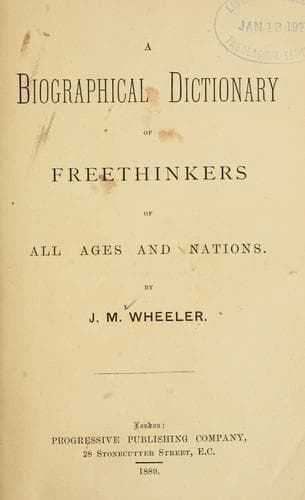
A Biographical Dictionary of Freethinkers of All Ages and NationsWheeler, J. M. (Joseph Mazzini)
Religion
A Biographical Dictionary of Freethinkers of All Ages and Nations
Wheeler, J. M. (Joseph Mazzini)
Free thought -- Biography
Hagen (Benjamin Olive), Socialist, b. 25 June, 1791. About the year
1841 his attention was attracted to the Socialists by the abuse they
received. Led thus to inquire, he embraced the views of Robert Owen,
and was their chief upholder for many years in the town of Derby,
where he lived to be upwards of seventy years of age. His wife also
deserves mention as an able lady of Freethought views.
Halley (Edmund), eminent English astronomer, known in his lifetime
as "the Infidel Mathematician," b. Haggerston, London, 29 Oct. 1656;
educated at Oxford. At twenty he had made observations of the planets
and of the spots on the sun. In Nov. '76 he went to St. Helena
where he prepared his Catalogue of Southern Stars, '79. He also
found how to take the sun's parallax by means of the transits of
Mercury or Venus. In '78 he was elected a F.R.S. Two years later
he made observation on "Halley's comet," and in '83 published his
theory of the variation of the magnet. He became a friend of Sir
Isaac Newton, whom he persuaded to publish his Principia. In '98 he
commanded a scientific expedition to the South Atlantic. In 1713 he
was made sec. of the Royal Society and in 1720 Astronomer-royal. He
then undertook a task which required nineteen years to perform, viz:
to observe the moon throughout an entire revolution of her nodes. He
lived to finish this task. Died 14 Jan. 1742. Halley was the first who
conceived that fixed stars had a proper motion in space. Chalmers in
his Biographical Dictionary says, "It must be deeply regretted that
he cannot be numbered with those illustrious characters who thought
it not beneath them to be Christians."
Hammon (W.), pseudonym of Turner William, q. v.
Hamond or Hamont (Matthew), English heretic, by trade a ploughwright,
of Hethersett, Norfolk, burnt at Norwich, May 1579, for holding
"that the New Testament and the Gospel of Christ were pure folly,
a human invention, a mere fable." He had previously been set in the
pillory and had both his ears cut off.
Hannotin (Emile), French Deist, b. Bar le Duc in 1812, and some
time editor of the Journal de la Meuse. Author of New Philosophical
Theology, '46; Great Questions, '67; Ten Years of Philosophical
Studies, '72; and an Essay on Man, in which he seeks to explain life
by sensibility.
Hanson (Sir Richard Davies), Chief Justice of South Australia,
b. London, 5 Dec. 1805. He practised as attorney for a short time in
London, and wrote for the Globe and Morning Chronicle. In 1830 he took
part in the attempt to found a colony in South Australia. In 1851 he
became Advocate-General of the colony, and subsequently in 1861 Chief
Justice. In 1869 he was knighted. He wrote on Law in Nature 1865,
The Jesus of History 1869, and St. Paul 1875. Hanson wrote Letters
to and from Rome A.D. 61, 62 and 63. Selected and translated by
C.V.S. 1873. Died at Adelaide 10 Mar. 1876.
Public-domain text, read in full here on John Shaqi.
Reviews
Reviews
No reviews yet
Be the first to share your thoughts on this work.
Elsewhere in the archive
Join the Discussion
Join the discussion
Sign in to leave a comment or review.
Sign InorCreate an account