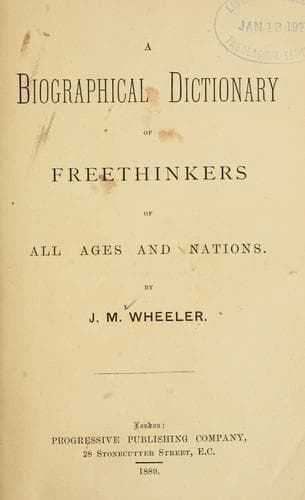
A Biographical Dictionary of Freethinkers of All Ages and NationsWheeler, J. M. (Joseph Mazzini)
Religion
A Biographical Dictionary of Freethinkers of All Ages and Nations
Wheeler, J. M. (Joseph Mazzini)
Free thought -- Biography
Helvetius (Claude Adrien) French philosopher, b. Paris 18
Jan. 1715. Descended from a line of celebrated physicians, he had a
large fortune which he dispensed in works of benevolence. Attracted
by reading Locke he resigned a lucrative situation as farmer-general
to devote himself to philosophy. In August 1758 he published a work
On the Mind (De L'Esprit) which was condemned by Pope Clement XIII,
31 Jan. 1759, and burnt by the order of Parliament 6 Feb. 1759 for the
hardihood of his materialistic opinions. Mme. Du Deffand said "he told
everybody's secret." It was republished at Amsterdam and London. He
also wrote a poem On Happiness and a work on Man his Faculties and
Education. He visited England and Prussia and became an honored guest
of Frederick the Great. Died 26 Dec. 1771. His wife, née Anne Catherine
De Lingville, b. 1719, after his death retired to Auteuil, where her
house was the rendezvous of Condillac, Turgot, d'Holbach, Morellet,
Cabanis, Destutt de Tracy, etc. This re-union of Freethinkers was
known as the Société d'Auteuil. Madame Helvetius died 12 August 1800.
Henault, or Hesnault (Jean), French Epicurean poet of the 17th century,
son of a Paris baker, was a pupil of Gassendi, and went to Holland to
see Spinoza. Bayle says he professed Atheism, and had composed three
different systems of the mortality of the soul. His most famous sonnet
is on The Abortion. Died Paris, 1682.
Henin de Cuvillers (Etienne Felix), Baron, French general and writer,
b. Balloy, 27 April, 1755. He served as diplomatist in England, Venice,
and Constantinople. Employed in the army of Italy, he was wounded at
Arcola, 26 Sept. '96. He was made Chevalier of the Legion of Honor in
1811. He wrote much, particularly on magnetism. In the 8th vol. of
his Archives du Magnétisme Animal, he suggests that the miracles of
Jesus were not supernatural, but wrought by means of magnetism learnt
in Egypt. In other writings, especially in reflections on the crimes
committed in the name of religion, '22, he shows himself the enemy
of fanaticism and intolerance. Died 2 August, 1841.
Hennell (Charles Christian), English Freethinker, b. 9 March, 1809,
author of an able Inquiry concerning the Origin of Christianity,
first published in '38, a work which powerfully influenced "George
Eliot," and a translation of which was introduced to German readers
by Dr. D. F. Strauss. It was Hennell who induced "George Eliot"
to translate Strauss's Life of Jesus. He also wrote on Christian
Theism. Hennell lived most of his time in Coventry. He was married
at London in '39, and died 2 Sept. 1850.
Public-domain text, read in full here on John Shaqi.
Reviews
Reviews
No reviews yet
Be the first to share your thoughts on this work.
Elsewhere in the archive
Join the Discussion
Join the discussion
Sign in to leave a comment or review.
Sign InorCreate an account