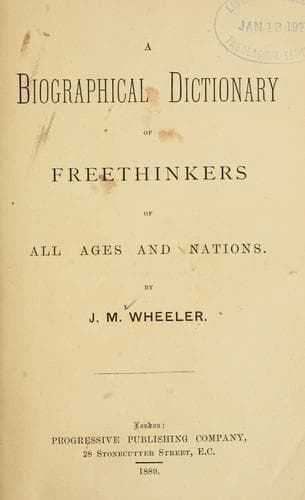
A Biographical Dictionary of Freethinkers of All Ages and NationsWheeler, J. M. (Joseph Mazzini)
Religion
A Biographical Dictionary of Freethinkers of All Ages and Nations
Wheeler, J. M. (Joseph Mazzini)
Free thought -- Biography
Heine (Heinrich), German poet and littérateur, b. of Jewish parents
at Dusseldorf, 31 Dec. 1797. He studied law at Bonn, Berlin, and
Göttingen; became acquainted with the philosophy of Spinoza and
Hegel; graduated LL.D., and in June 1825 renounced Judaism and
was baptised. The change was only formal. He satirised all forms
of religious faith. His fine Pictures of Travel was received with
favor and translated by himself into French. His other principal
works are the Book of Songs, History of Recent Literature in Germany,
The Romantic School, The Women of Shakespeare, Atta Troll and other
poems. In 1835 he married a French lady, having settled in Paris,
where "the Voltaire of Germany" became more French than German. About
1848 he became paralysed and lost his eyesight, but he still employed
himself in literary composition with the aid of an amanuensis. After
an illness of eight years, mostly passed in extreme suffering on his
"mattress grave," he died 17 Feb. 1856. Heine was the greatest and
most influential German writer since Goethe. He called himself a
Soldier of Freedom, and his far-flashing sword played havoc with the
forces of reaction.
Heinzen (Karl Peter) German-American poet, orator and politician,
b. near Dusseldorf, 22 Feb. 1809. He studied medicine at Bonn,
and travelled to Batavia, an account of which he published (Cologne
1842). A staunch democrat, in 1845 he published at Darmstadt a work
on the Prussian Bureaucracy, for which he was prosecuted and had to
seek shelter in Switzerland. At Zurich he edited the German Tribune
and the Democrat. At the beginning of '48 he visited New York but
returned to participate in the attempted German Revolution. Again
"the regicide" had to fly and in August '50 returned to New York. He
wrote on many papers and established the Pioneer (now Freidenker),
first in Louisville, then in Cincinnati, then in New York, and from
'59 in Boston. He wrote many works, including Letters on Atheism,
which appeared in The Reasoner 1856, Poems, German Revolution, The
Heroes of German Communism, The Rights of Women, Mankind the Criminal,
Six Letters to a Pious Man (Boston 1869), Lessons of a Century,
and What is Humanity? (1877.) Died Boston 12 Nov. 1880.
Hellwald (Friedrich von), German geographer, b. Padua 29 March 1842,
and in addition to many works on various countries has written an
able Culture History, 1875.
Helmholtz (Hermann Ludwig Ferdinand von) German scientist, b. Potsdam
31 Aug. 1821. Distinguished for his discoveries in acoustics, optics
and electricity, he is of the foremost rank among natural philosophers
in Europe. Among his works we mention The Conservation of Force (1847),
and Popular Scientific Lectures (1865-76.) Professor Helmholtz rejects
the design hypothesis.
Public-domain text, read in full here on John Shaqi.
Reviews
Reviews
No reviews yet
Be the first to share your thoughts on this work.
Elsewhere in the archive
Join the Discussion
Join the discussion
Sign in to leave a comment or review.
Sign InorCreate an account