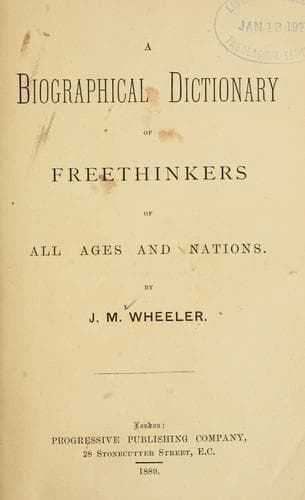
A Biographical Dictionary of Freethinkers of All Ages and NationsWheeler, J. M. (Joseph Mazzini)
Religion
A Biographical Dictionary of Freethinkers of All Ages and Nations
Wheeler, J. M. (Joseph Mazzini)
Free thought -- Biography
Hertzen or Gertsen (Aleksandr Ivanovich), Russian patriot, chief of
the revolutionary party, b. Moscow, 25 March, 1812. He studied at
Moscow University, where he obtained a high degree. In '34 he was
arrested for Saint Simonian opinions and soon afterwards banished
to Viatka, whence he was permitted to return in '37. He was expelled
from Russia in '42, visited Italy, joined the "Reds" at Paris in '48,
took refuge at Geneva, and soon after came to England. In '57 he set
up in London a Russian printing press for the publication of works
prohibited in Russia, and his publications passed into that country in
large numbers. Among his writings are Dilettantism in Science, '42;
Letters on the Study of Nature, '45-46; Who's to Blame? '57; Memoirs
of the Empress Catherine, and My Exile, '55. In '57 Herzen started the
magazine the Kolokol or Bell. Died at Paris, 21 Jan. 1870. His son,
Alessandro Herzen, b. Wladimar, 1839, followed his father's fortunes,
learnt most of the European languages and settled at Florence, where
he did much to popularise physiological science. He has translated
Maudsley's Physiology of Mind, and published a physiological analysis
of human free will.
Herwegh (Georg), German Radical and poet, b. Stuttgart, 31
May, 1817. Intended for the Church, he left that business for
Literature. His Gedichte eines Lebendigen (Poems of a Living Man)
aroused attention by their boldness. In '48 he raised a troop
and invaded Baden, but failed, and took refuge in Switzerland and
Paris. Died at Baden-Baden, 7 April, 1875.
Hetherington (Henry), English upholder of a free press, b. Soho,
London, 1792. He became a printer, and was one of the most energetic
of working men engaged in the foundation of mechanics' institutes. He
also founded the Metropolitan Political Union in March, 1830, which
was the germ both of trades' unionism and of the Chartist movement. He
resisted the "taxes upon knowledge" by issuing unstamped The Poor Man's
Guardian, a weekly newspaper for the people, established, contrary to
"law," to try the power of "might" against "right," '31-35. For this
he twice suffered sentences of six months' imprisonment. He afterwards
published The Unstamped, and his persistency had much to do in removing
the taxes. While in prison he wrote his Cheap Salvation in consequence
of conversation with the chaplain of Clerkenwell Gaol. On Dec. 8, '40,
he was tried for "blasphemous libel" for publishing Haslam's Letters
to the Clergy, and received four month's imprisonment. Hetherington
published A Few Hundred Bible Contradictions, and other Freethought
works. Much of his life was devoted to the propaganda of Chartism. He
died 24 Aug. 1849, leaving a will declaring himself an Atheist.
Public-domain text, read in full here on John Shaqi.
Reviews
Reviews
No reviews yet
Be the first to share your thoughts on this work.
Elsewhere in the archive
Join the Discussion
Join the discussion
Sign in to leave a comment or review.
Sign InorCreate an account