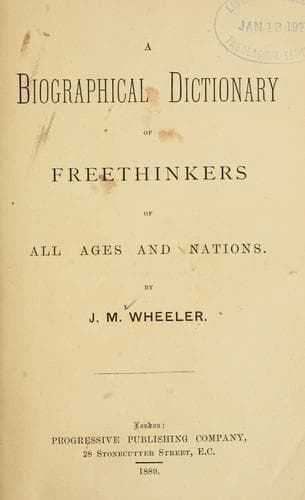
A Biographical Dictionary of Freethinkers of All Ages and NationsWheeler, J. M. (Joseph Mazzini)
Religion
A Biographical Dictionary of Freethinkers of All Ages and Nations
Wheeler, J. M. (Joseph Mazzini)
Free thought -- Biography
Hetzer (Ludwig), anti-Trinitarian martyr, b. Bischopzell, Switzerland;
was an Anabaptist minister at Zurich. He openly denied the doctrine of
the Trinity, and was condemned to death by the magistrates of Constance
on a charge of blasphemy. The sentence was carried out 4 Feb. 1529.
Heusden (C. J. van), Dutch writer in De Dageraad. Has written several
works, Thoughts on a Coming More Universal Doctrine, by a Believer,
etc.
Hibbert (Julian), Freethought philanthropist, b. 1801. During the
imprisonment of Richard Carlile he was active in sustaining his
publications. Learning that a distinguished political prisoner had
received a gift of £1,000, he remarked that a Freethinking prisoner
should not want equal friends, and gave Carlile a cheque for the same
amount. Julian Hibbert spent nearly £1,000 in fitting up Carlile's
shop in Fleet Street. He contributed "Theological Dialogues" to the
Republican, and also contributed to the Poor Man's Guardian. Hibbert
set up a private press and printed in uncial Greek the Orphic Hymns,
'27, and also Plutarch and Theophrastus on Superstition, to which
he wrote a life of Plutarch and appended valuable essays "on the
supposed necessity of deceiving the vulgar"; "various definitions
of an important word" [God], and a catalogue of the principal
modern works against Atheism. He also commenced a Dictionary
of Anti-Superstitionists, and Chronological Tables of British
Freethinkers. He wrote a short life of Holbach, published by James
Watson, to whom, and to Henry Hetherington, he left £500 each. Died
December 1834.
Hedin (Sven Adolph), Swedish member of the "Andra Kammaren" [House
of Commons], b. 1834. Studied at Upsala and became philosophical
candidate, '61. Edited the Aftonbladet, '74-76. Has written many
radical works.
Higgins (Godfrey), English archæologist, b. Skellow Grange, near
Doncaster, 1771. Educated at Cambridge and studied for the bar,
but never practised. Being the only son he inherited his father's
property, married, and acted as magistrate, in which capacity he
reformed the treatment of lunatics in York Asylum. His first work was
entitled Horæ Sabbaticæ, 1813, a manual on the Sunday Question. In
'29 he published An Apology for the Life and Character of Mohammed and
Celtic Druids, which occasioned some stir on account of the exposure
of priestcraft. He died 9 Aug. 1833, leaving behind a work on the
origin of religions, to the study of which he devoted ten hours daily
for about twenty years. The work was published in two volumes in 1826,
under the title of "Anacalypsis, an attempt to draw aside the veil of
the Saitic Isis; or an Inquiry into the Origin of Languages, Nations,
and Religions."
Public-domain text, read in full here on John Shaqi.
Reviews
Reviews
No reviews yet
Be the first to share your thoughts on this work.
Elsewhere in the archive
Join the Discussion
Join the discussion
Sign in to leave a comment or review.
Sign InorCreate an account