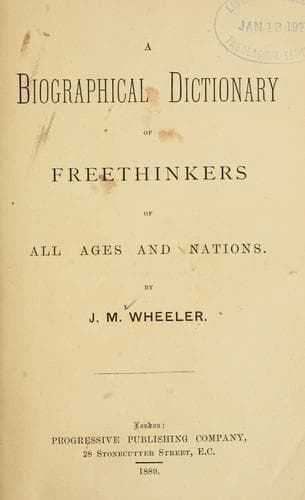
A Biographical Dictionary of Freethinkers of All Ages and NationsWheeler, J. M. (Joseph Mazzini)
Religion
A Biographical Dictionary of Freethinkers of All Ages and Nations
Wheeler, J. M. (Joseph Mazzini)
Free thought -- Biography
Hodgson (William, M.D.), English Jacobin, translator of d'Holbach's
System of Nature (1795). In 1794 he was confined in Newgate for two
years for drinking to the success of the French Republic. In prison
he wrote The Commonwealth of Reason.
Hoelderlin (Johann Christian Friedrich), German pantheistic poet,
b. Laufen, 20 March, 1770. Entered as a theological student at
Tübingen, but never took to the business. He wrote Hyperion, a
fine romance (1797-99), and Lyric Poems, admired for their depth of
thought. Died Tübingen, 7 June, 1843.
Hoijer (Benjamin Carl Henrik), Swedish philosopher, b. Great Skedvi,
Delecarlia, 1 June, 1767. Was student at Upsala University '83,
and teacher of philosophy '98. His promotion was hindered by his
liberal opinions. By his personal influence and published treatises he
contributed much to Swedish emancipation. In 1808 he became Professor
of Philosophy at Upsala. Died 8 June, 1812.
Holbach (Paul Heinrich Dietrich von) Baron, b. Heidelsheim
Jan. 1723. Brought up at Paris where he spent most of his life. Rich
and generous he was the patron of the Encyclopædists. Buffon, Diderot,
d'Alembert, Helvetius, Rousseau, Grimm, Raynal, Marmontel, Condillac,
and other authors often met at his table. Hume, Garrick, Franklin,
and Priestley were also among his visitors. He translated from the
German several works on chemistry and mineralogy, and from the English,
Mark Akenside's Pleasures of the Imagination. He contributed many
articles to the Encyclopédie. In 1765 he visited England, and from
this time was untiring in his issue of Freethought works, usually put
out under pseudonyms. Thus he wrote and had published at Amsterdam
Christianity Unveiled, attributed to Boulanger. The Spirit of the
Clergy, translated, from the English of Trenchard and Gordon, was
partly rewritten by d'Holbach, 1767. His Sacred Contagion or Natural
History of Superstition, was also wrongly attributed to Trenchard
and Gordon. This work was condemned to be burnt by a decree of the
French parliament, 8 Aug. 1770. D'Holbach also wrote and published
The History of David, 1768, The Critical History of Jesus Christ,
Letters to Eugenia, attributed to Freret, Portable Theology, attributed
to Bernier, an Essay on Prejudices, attributed to M. Du M [arsais],
Religious Cruelty, Hell Destroyed, and other works, said to be from
the English. He also translated the Philosophical Letters of Toland,
and Collins's Discourses on Prophecy, and attributed to the latter a
work with the title The Spirit of Judaism. These works were mostly
conveyed to the printer, M. Rey, at Amsterdam, by Naigeon, and the
secret of their authorship was carefully preserved. Hence d'Holbach
escaped persecution. In 1770 he published his principal work The
System of Nature, or The Laws of the Physical and Moral World. This
text-book of atheistic philosophy, in which d'Holbach was assisted
by Diderot, professed to be the posthumous work of Mirabaud. It made
a great sensation.
Public-domain text, read in full here on John Shaqi.
Reviews
Reviews
No reviews yet
Be the first to share your thoughts on this work.
Elsewhere in the archive
Join the Discussion
Join the discussion
Sign in to leave a comment or review.
Sign InorCreate an account