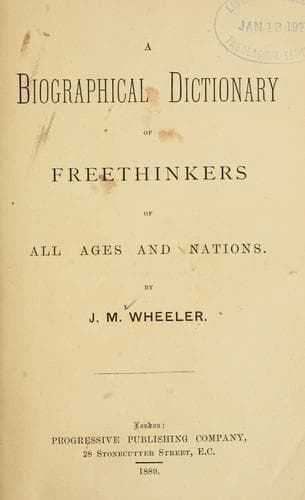
A Biographical Dictionary of Freethinkers of All Ages and NationsWheeler, J. M. (Joseph Mazzini)
Religion
A Biographical Dictionary of Freethinkers of All Ages and Nations
Wheeler, J. M. (Joseph Mazzini)
Free thought -- Biography
Hillebrand (Karl), cosmopolitan writer, b. 17 Sept. 1829, at
Giessen. His father, Joseph Hillebrand, succeeded Hegel as professor
at Heidelberg. Involved in the revolutionary movement in Germany,
Karl was imprisoned in the fortress of Rastadt, whence he escaped to
France. He taught at Strasbourg and Paris, where he became secretary
to Heine. On the poet's death he removed to Bordeaux, where he became a
naturalised Frenchman. He became professor of letters at Douay. During
the Franco-Prussian war he was correspondent to the Times, and was
taken for a Prussian spy. In 1871 he settled at Florence, where he
translated the poems of Carducci. Hillebrand was a contributor to
the Fortnightly Review, Nineteenth Century, Revue des deux Mondes,
North American Review, etc. His best known work is on France and the
French in the second half of the nineteenth century. Died at Florence,
18 Oct. 1884.
Hins (Eugène), Belgian writer, Dr. of Philosophy, Professor at Royal
Athenæum, Charleroi, b. St. Trond, 1842. As general secretary of the
International, he edited L'Internationale, in which he laid stress
on anti-religious teaching. He contributed to La Liberté, and was
one of the prominent lecturers of the Societies Les Solidaires, and
La Libre-pensée of Brussels. He has written La Russie dé voilée au
moyen de sa littérature populaire, 1883, and other works.
Hippel (Theodor Gottlieb von), German humoristic poet, b. Gerdauen,
Prussia, 31 Jan. 1741. He studied theology, but resigned it for law,
and became in 1780 burgomaster of Königsberg. His writings, which were
published anonymously, betray his advanced opinions. Died Bromberg,
23 April, 1796.
Hittell (John S.), American Freethinker, author of the Evidences
against Christianity (New York, 1857): has also written A Plea for
Pantheism, A New System of Phrenology, The Resources of California,
a History of San Francisco, A Brief History of Culture (New York,
1875), and St. Peter's Catechism (Geneva, 1883).
Hoadley (George), American jurist, b. New Haven, Conn., 31 July,
1836. He studied at Harvard, and in '47 was admitted to the bar,
and in '51 was elected judge of the superior court of Cincinnati. He
afterwards resigned his place and established a law firm. He was one
of the counsel that successfully opposed compulsory Bible reading in
the public schools.
Hobbes (Thomas), English philosopher, b. Malmesbury, 5 April,
1588. In 1608 he became tutor to a son of the Earl of Devonshire,
with whom he made the tour of Europe. At Pisa in 1628 he made the
acquaintance of Galileo. In 1642 he printed his work De Cive. In 1650
appeared in English his work on Human Nature, and in the following
year his famous Leviathan. At the Restoration he received a pension,
but in 1666 Parliament, in a Bill against Atheism and profaneness,
passed a censure on his writings, which much alarmed him. The latter
years of his life were spent at the seat of the Duke of Devonshire,
Chatsworth, where he died 4 Dec. 1679.
Public-domain text, read in full here on John Shaqi.
Reviews
Reviews
No reviews yet
Be the first to share your thoughts on this work.
Elsewhere in the archive
Join the Discussion
Join the discussion
Sign in to leave a comment or review.
Sign InorCreate an account