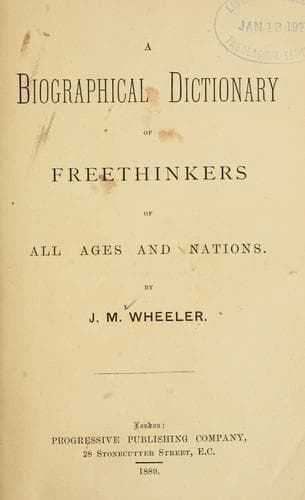
A Biographical Dictionary of Freethinkers of All Ages and NationsWheeler, J. M. (Joseph Mazzini)
Religion
A Biographical Dictionary of Freethinkers of All Ages and Nations
Wheeler, J. M. (Joseph Mazzini)
Free thought -- Biography
Holyoake (George Jacob), b. Birmingham, 13 April 1817. Became
mathematical teacher of the Mechanics' Institution. Influenced by Combe
and Owen he became a Freethinker, and in '40 a Socialist missionary. In
'42, when Southwell was imprisoned for writing in the Oracle of Reason,
Mr. Holyoake took charge of that journal, and wrote The Spirit of
Bonner in the Disciples of Jesus. He was soon arrested for a speech
at Cheltenham, having said, in answer to a question, that he would put
the Deity on half-pay. Tried Aug. '42, he was sentenced to six months
imprisonment, of which he gave a full account in his Last Trial by
Jury for Atheism in England. In Dec. '43 he edited with M. Q. Ryall
the Movement, bearing the motto from Bentham, "Maximise morals,
minimise religion." The same policy was pursued in The Reasoner,
which he edited from 1846 till 1861. Among his many pamphlets we must
notice the Logic of Death, '50, which went through numerous editions,
and was included in his most important Freethought work, The Trial
of Theism. In '49 he published a brief memoir of R. Carlile. In
'51 he first used the term "Secularist," and in Oct. '52 the first
Secular Conference was held at Manchester Mr. Holyoake presiding. In
Jan. '53 he held a six nights discussion with the Rev. Brewin Grant,
and again in Oct. '54. He purchased the business of James Watson,
and issued many Freethought works, notably The Library of Reason--a
series, The Cabinet of Reason, his own Secularism, The Philosophy of
the People, etc. In '60 he was Secretary to the British Legion sent out
to Garibaldi. Mr. Holyoake did much to remove the taxes upon knowledge,
and has devoted much attention to Co-operation, having written a
history of the movement and contributed to most of its journals.
Home (Henry), Scottish judge, was b. 1696. His legal ability was
made known by his publication of Remarkable Decisions of the Court of
Session, 1728. In 1752 he was raised to the bench as Lord Kames. He
published Essays on the Principles of Morality and Natural Religion
(1751), Elements of Criticism (1762), and Sketches of the History
of Man, in which he proved himself in advance of his age. Died 27
Dec. 1782.
Hon, Le (Henri). See Le Hon.
Hooker (Sir Joseph Dalton), English naturalist, b. 1817. He
studied medicine at Glasgow, graduating M.D '39. In '55 he
became assistant-director of Kew Gardens, and from '65-85 sole
director. Renowned as a botanist, he was the first eminent man of
science to proclaim his adoption of Darwinism.
Hope (Thomas), novelist and antiquarian, b. 1770. Famous for his
anonymous Anastasius, or Memories of a Modern Greek, he also wrote an
original work on The Origin and Prospects of Man '31. Died at London
3 Feb. 1831.
Public-domain text, read in full here on John Shaqi.
Reviews
Reviews
No reviews yet
Be the first to share your thoughts on this work.
Elsewhere in the archive
Join the Discussion
Join the discussion
Sign in to leave a comment or review.
Sign InorCreate an account