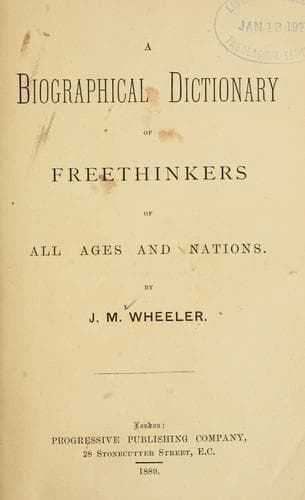
A Biographical Dictionary of Freethinkers of All Ages and NationsWheeler, J. M. (Joseph Mazzini)
Religion
A Biographical Dictionary of Freethinkers of All Ages and Nations
Wheeler, J. M. (Joseph Mazzini)
Free thought -- Biography
Hutten (Ulrich von), German poet and reformer, b. of noble family
Steckelberg, Hesse Cassel, 22 April 1488. He was sent to Fulda
to become a monk, but fled in 1504 to Erfurt, where he studied
humaniora. After some wild adventures he went to Wittenberg in 1510,
and Vienna 1512, and also studied at Pavia and Bologna. He returned to
Germany in 1517 as a common soldier in the army of Maximilian. His
great object was to free his country from sacerdotalism, and
most of his writings are satires against the Pope, monks and
clergy. Persecution drove him to Switzerland, but the Council of
Zurich drove him out of their territory and he died on the isle of
Ufnau, Lake Zürich, 29 Aug. 1523.
Hutton (James), Scotch geologist and philosopher, b. at Edinburgh 3
June, 1736. He graduated as M.D. at Leyden in 1749, and investigated
the strata of the north of Scotland. He published a dissertation
on Light, Heat, and Fire, and in his Theory of the World, 1795,
attributes geological phenomena to the action of fire. He also wrote
a work entitled An Investigation of the Principles of Knowledge,
the opinions of which, says Chalmers, "abound in sceptical boldness
and philosophical infidelity." Died 26 March 1797.
Huxley (Thomas Henry), LL.D., Ph.D., F.R.S., b. Ealing, 4 May, 1825. He
studied medicine, and in '46 took M.R.C.S., and was appointed assistant
naval surgeon. His cruises afforded opportunities for his studies of
natural history. In '51 he was elected Fellow of the Royal Society, and
in '54 was made Professor at the School of Mines. In '60 he lectured on
"The Relation of Man to the Lower Animals," and afterwards published
Evidence as to Man's Place in Nature (1863). In addition to numerous
scientific works, Professor Huxley has written numerous forcible
articles, addresses, etc., collected in Lay Sermons, '70; Critiques
and Addresses, '73; and American Addresses, '79. A vigorous writer,
his Hume in the "English Men of Letters" series is a model of clear
exposition. In his controversies with Mr. Gladstone, in his articles
on the Evolution of Theology, and in his recent polemic with the
Rev. Mr. Wace in the Nineteenth Century, Professor Huxley shows all
his freshness, and proves himself as ready in demolishing theological
fictions as in demonstrating scientific facts. He states as his own
life aims "The popularising of science and untiring opposition to
that ecclesiastical spirit, that clericalism, which in England,
as everywhere else, and to whatever denomination it may belong,
is the deadly enemy of science."
Public-domain text, read in full here on John Shaqi.
Reviews
Reviews
No reviews yet
Be the first to share your thoughts on this work.
Elsewhere in the archive
Join the Discussion
Join the discussion
Sign in to leave a comment or review.
Sign InorCreate an account