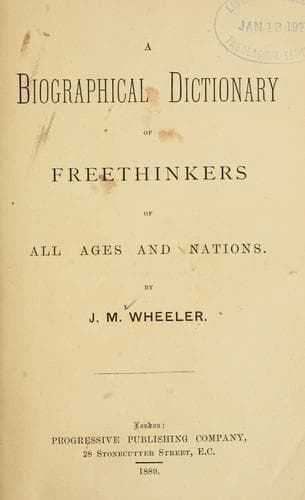
A Biographical Dictionary of Freethinkers of All Ages and NationsWheeler, J. M. (Joseph Mazzini)
Religion
A Biographical Dictionary of Freethinkers of All Ages and Nations
Wheeler, J. M. (Joseph Mazzini)
Free thought -- Biography
Humboldt (Karl Wilhelm von), Prussian statesman and philosopher,
b. Potsdam, 22 June, 1767. He was educated by Campe. Went to Paris in
1789, and hailed the revolution with enthusiasm. In '92 he published
Ideas on the Organization of the State. He became a friend of Schiller
and Goethe, and in 1809 was Minister of Public Instruction. He took
part in founding the University of Berlin. He represented Prussia at
the Congress of Vienna, '14. He advocated a liberal constitution, but
finding the King averse, retired at the end of '19, and devoted himself
to the study of comparative philology. He said there were three things
he could not comprehend--orthodox piety, romantic love, and music. He
died 8 April, 1835. His works were collected and edited by his brother.
Hume (David), philosopher and historian, b. Edinburgh, 26 April,
1711. In 1735 he went to France to study, and there wrote his Treatise
on Human Nature, published in 1739. This work then excited no interest
friendly or hostile. Hume's Essays Moral and Political appeared in
1742, and in 1752 his Inquiry Concerning the Principles of Morals which
of all his writings he considered the best. In 1755 he published his
Natural History of Religion, which was furiously attacked by Warburton
in an anonymous tract. In 1754 he published the first volume of his
History of England, which he did not complete till 1761. He became
secretary to the Earl of Hertford, ambassador at Paris, where he was
cordially welcomed by the philosophers. He returned in 1766, bringing
Rousseau with him. Hume became Under Secretary of State in 1767,
and in 1769 retired to Edinburgh, where he died 25 Aug. 1776. After
his death his Dialogues on Natural Religion were published, and also
some unpublished essays on Suicide, the Immortality of the Soul,
etc. Hume's last days were singularly cheerful. His friend, the famous
Dr. Adam Smith, considered him "as approaching as nearly to the idea
of a perfectly wise and virtuous man as perhaps the nature of human
frailty will permit."
Hunt (James), Ph.D., physiologist, b. 1833, was the founder of the
Anthropological Society, of which he was the first president, '63. He
was the author of the Negro's Place in Nature, a work on Stammering,
etc. Died 28 Aug. 1869.
Hunt (James Henry Leigh), poet, essayist and critic, b. Southgate,
Middlesex, 19 Oct. 1784. was educated with Lamb and Coleridge at
Christ's Hospital, London. He joined his brother John in editing
first the Sunday News, 1805, and then the Examiner, 1808. They were
condemned to pay a fine, each of £500, and to be imprisoned for
two years, 1812-14, for a satirical article, in which the prince
regent was called an "Adonis of fifty." This imprisonment procured
him the friendship of Shelley and Byron, with whom, after editing
the Indicator he was associated in editing the Liberal. He wrote many
choice books of poems and criticisms, and in his Religion of the Heart,
'53, repudiates orthodoxy. Died 28 Aug. 1859.
Public-domain text, read in full here on John Shaqi.
Reviews
Reviews
No reviews yet
Be the first to share your thoughts on this work.
Elsewhere in the archive
Join the Discussion
Join the discussion
Sign in to leave a comment or review.
Sign InorCreate an account