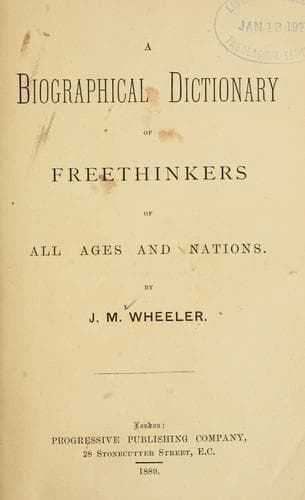
A Biographical Dictionary of Freethinkers of All Ages and NationsWheeler, J. M. (Joseph Mazzini)
Religion
A Biographical Dictionary of Freethinkers of All Ages and Nations
Wheeler, J. M. (Joseph Mazzini)
Free thought -- Biography
Jones (John Gale), Political orator, b. 1771. At the time of the French
Revolution he became a leading member of the London Corresponding
Society. Arrested at Birmingham for sedition, he obtained a verdict of
acquittal. He was subsequently committed to Newgate in Feb. 1810, for
impugning the proceedings of the House of Commons, and there remained
till his liberation was effected by the prorogation of Parliament,
June 21. On 26 Dec. '11 he was again convicted for "a seditious and
blasphemous libel." He was a resolute advocate of the rights of free
publication during the trials of Carlile and his shopmen. Died Somers
Town, 4 April, 1838.
Jones (Lloyd), Socialist, b. of Catholic parents at Brandon, co. Cork,
Ireland, in March, 1811. In '27 he came over to Manchester, and
in '32 joined the followers of Robert Owen. He became "a social
missionary," and had numerous debates with ministers, notably one on
"The Influence of Christianity" with J. Barker, then a Methodist, at
Manchester, in '39. Lloyd Jones was an active supporter of co-operation
and trades-unionism, and frequently acted as arbitrator in disputes
between masters and men. He contributed to the New Moral World, Spirit
of the Age, Glasgow Sentinel, Leeds Express, North British Daily Mail,
Newcastle Chronicle, and Co-operative News. Died at Stockwell, 22 May,
1886, leaving behind a Life of Robert Owen.
Joseph II., Emperor of Germany, son of Francis I. and Maria Theresa,
b. Vienna 13 March 1741. In 1764 he was elected king of the Romans, and
in the following year succeeded to the throne of Germany. He wrought
many reforms, suppressed the Jesuits 1773, travelled in France as Count
Falkenstein, saw d'Alembert but did not visit Voltaire. He abolished
serfdom, allowed liberty of conscience, suppressed several convents,
regulated others, abridged the power of the pope and the clergy,
and mitigated the condition of the Jews. Carlyle says "a mighty
reformer he had been, the greatest of his day. Austria gazed on him,
its admiration not unmixed with terror. He rushed incessantly about,
hardy as a Charles Twelfth; slept on his bearskin on the floor of any
inn or hut;--flew at the throat of every absurdity, however broad
and based or dangerously armed. 'Disappear I say.' A most prompt,
severe, and yet beneficent and charitable kind of man. Immensely
ambitious, that must be said withal. A great admirer of Friedrich;
bent to imitate him with profit. 'Very clever indeed' says Friedrich,
'but has the fault (a terribly grave one!) of generally taking the
second step without having taken the first.'" Died Vienna 20 Feb. 1790.
Jouy (Victor Joseph Etienne de), French author b. Jouy near Versailles
1764. He served as soldier in India and afterwards in the wars of
the Republic. A disciple of Voltaire to whom he erected a temple,
he was a prolific writer, his plays being much esteemed in his own
day. Died 4 Sept. 1846.
Public-domain text, read in full here on John Shaqi.
Reviews
Reviews
No reviews yet
Be the first to share your thoughts on this work.
Elsewhere in the archive
Join the Discussion
Join the discussion
Sign in to leave a comment or review.
Sign InorCreate an account