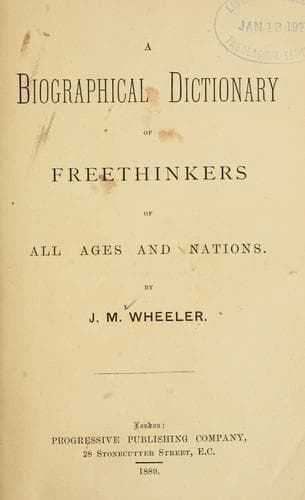
A Biographical Dictionary of Freethinkers of All Ages and NationsWheeler, J. M. (Joseph Mazzini)
Religion
A Biographical Dictionary of Freethinkers of All Ages and Nations
Wheeler, J. M. (Joseph Mazzini)
Free thought -- Biography
Jefferson (Thomas), American statesman, b. Shadwell, Virginia, 2 April
1743. He studied law and was admitted to the bar in 1767. He became
a member of the House of Burgesses, 1769-75. In 1774 he published
his Summary Views of the Rights of British-Americans. He drafted
and reported to Congress the "Declaration of Independence" which
was unanimously adopted, 4 July 1766. He was Governor of Virginia
from 1719 to 1781, and originated a system of education in the
State. He was Ambassador to Paris from 1785-89, secretary of state
from 1789-93, vice-president 1791-1801 and third president of the
United States 1801-9. In '19 he founded the University of Virginia, of
which he was rector till his death, 4 July 1826. Dr. J. Thomas in his
Dictionary of Biography says "In religion he was what is denominated a
freethinker." He spoke in old age of "the hocus-pocus phantom of God,
which like another Cerberus had one body and three heads." See his
life by J. Parton.
Johnson (Richard Mentor), Colonel, American soldier and statesman,
b. Bryant's Station, Kentucky, 17 Oct. 1781. Was educated at Lexington,
studied law, and practiced with success. Became member of the Kentucky
Legislature in 1805, and raised a regiment of cavalry '12. Fought
with distinction against British and Indians. Was member of Congress
from 1807-19, and from '29-37; a United States Senator from '19-29,
and Vice-President of the United States, '37-40. Is remembered by his
report against the suspension of Sunday mails and his speeches in favor
of rights of conscience. Died at Frankfort, Kentucky, 19 Nov. 1850.
Johnson (Samuel), American author, b. Salem, Massachusetts, 10
Oct. 1822. He was educated at Harvard, and became pastor of a "Free
Church" at Lynn in '53. He never attached himself to any denomination,
although in some points his views were like those of the Unitarians
and Universalists. About '46 he published, in conjunction with
S. Longfellow, brother of the poet, Hymns of the Spirit, Oriental
Religions in relation to Universal Religion, of which the volume
on India appeared in '72, China '77, and Persia '84. Died Andover,
19 Feb. 1882.
Jones (Ernest Charles), barrister and political orator, b. Berlin,
25 Jan. 1819. His father was in the service of the King of Hanover,
who became his godfather. Called to the bar in '44 in the following
year he joined the Chartist movement, editing the People's Paper, Notes
to the People, and other Chartist periodicals. In '48 he was tried for
making a seditious speech, and condemned to two years' imprisonment,
during which he wrote Beldagon Church and other poems. He stood for
Halifax in '47, and Nottingham in '53 and '57, without success. He
was much esteemed by the working classes in Manchester, where he died
26 Jan. 1869.
Public-domain text, read in full here on John Shaqi.
Reviews
Reviews
No reviews yet
Be the first to share your thoughts on this work.
Elsewhere in the archive
Join the Discussion
Join the discussion
Sign in to leave a comment or review.
Sign InorCreate an account