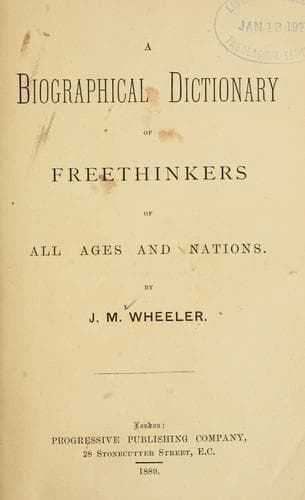
A Biographical Dictionary of Freethinkers of All Ages and NationsWheeler, J. M. (Joseph Mazzini)
Religion
A Biographical Dictionary of Freethinkers of All Ages and Nations
Wheeler, J. M. (Joseph Mazzini)
Free thought -- Biography
Kneeland (Abner), American writer, b. Gardner, Mass., 7 April, 1774,
became a Baptist and afterwards a Universalist minister. He invented
a new system of orthography, published a translation of the New
Testament, 1823, The Deist (2 Vols.), '22, edited the Olive Branch
and the Christian Inquirer. He wrote The Fourth Epistle of Peter,
'29, and a Review of the Evidences of Christianity, being a series
of lectures delivered in New York in '29. In that year he removed to
Boston, and in April '31 commenced the Boston Investigator, the oldest
Freethought journal. In '33 he was indicted and tried for blasphemy
for saying that he "did not believe in the God which Universalists
did." He was sentenced 21 Jan. '34, to two months' imprisonment and
fine of five hundred dollars. The verdict was confirmed in the Courts
of Appeal in '36, and he received two months' imprisonment. Kneeland
was a Pantheist. He took Frances Wright as an associate editor, and
soon after left the Boston Investigator in the hands of P. Mendum and
Seaver, and retired to a farm at Salubria, where he died 27 August,
1844. His edition, with notes, of Voltaire's Philosophical Dictionary,
was published in two volumes in 1852.
Knoblauch (Karl von), German author, b. Dillenburg, 3 Nov. 1757. He
was a friend of Mauvillon and published several works directed against
supernaturalism and superstition. Died at Bernburg, 6 Sept. 1794.
Knowlton (Charles) Dr., American physician and author, b. Templeton,
Mass., 10 May, 1800. He published the Fruits of Philosophy, for which
he was imprisoned in '32. He was a frequent correspondent of the Boston
Investigator, and held a discussion on the Bible and Christianity with
the Rev. Mr. Thacher of Harley. About '29 he published The Elements
of Modern Materialism. Died in Winchester, Mass., 20 Feb. 1850.
Knutzen (Matthias), b. Oldensworth, in Holstein, 1645. He early lost
his parents, and was brought to an uncle at Königsberg, where he
studied philosophy. He took to the adventurous life of a wandering
scholar and propagated his principles in many places. In 1674 he
preached Atheism publicly at Jena, in Germany, and had followers who
were called "Gewissener," from their acknowledging no other authority
but conscience. It is said there were seven hundred in Jena alone. What
became of him and them is unknown. A letter dated from Rome gives his
principles. He denied the existence of either God or Devil, deemed
churches and priests useless, and held that there is no life beyond
the present, for which conscience is a sufficient guide, taking the
place of the Bible, which contains great contradictions. He also
wrote two dialogues.
Public-domain text, read in full here on John Shaqi.
Reviews
Reviews
No reviews yet
Be the first to share your thoughts on this work.
Elsewhere in the archive
Join the Discussion
Join the discussion
Sign in to leave a comment or review.
Sign InorCreate an account