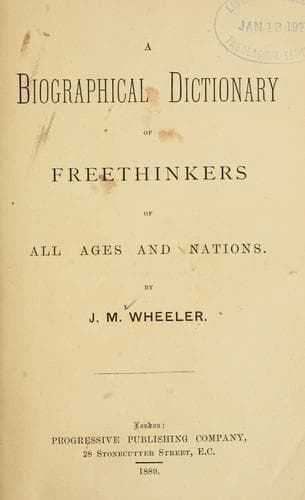
A Biographical Dictionary of Freethinkers of All Ages and NationsWheeler, J. M. (Joseph Mazzini)
Religion
A Biographical Dictionary of Freethinkers of All Ages and Nations
Wheeler, J. M. (Joseph Mazzini)
Free thought -- Biography
Mittermaier (Karl Josef Anton von), German jurisconsult, b. Munich,
5 Aug. 1787. Studied law and medicine at Landshut, where he became
professor. His works on Law gained him a high reputation. He obtained
a chair at the Heidelberg University. In 1831 he represented Baden in
Parliament. He advocated the unity of Germany and took an active part
in the Radical movement of '48. His writings are all in the direction
of freedom. Died 28 Aug. 1867.
Mittie (Stanilas), in 1789 proposed the taking of church bells to make
money and cannon, and during the revolution distinguished himself by
other anti-clerical suggestions. Died 1816.
Mocenicus (Philippus), Archbishop of Nicosia, Cyprus, a Venetian
philosopher, whose heretical Contemplations were printed at Geneva,
1588, with the Peripatetic Question of Cæsalpinus and the books of
Telesio on The Nature of Things in the volume entitled Tractationum
Philosophicarum.
Moleschott (Jacob), scientific Materialist, b. of Dutch parents at 's
Hertogenbosch, 9 Aug. 1822; studied at Heidelburg where he graduated
M.D. Became Professor of Physiology at Zurich and afterwards at
Turin. Becoming a naturalised Italian he was in '76 made a senator,
and in '78 Professor of Physiology at the University of Rome. He has
written Circulation of Life, Light and Life, Physiological Sketches,
and other medical and scientific works. Lange calls him "the father
of the modern Materialistic movement."
Molesworth (Sir William), statesman and man of letters, the eighth
baronet of his family, b. Cornwall, 23 May, 1810. In '32 he was
returned M.P. for East Cornwall, and from '37-41 sat for Leeds. In
'53 he was First Commissioner of Public Works, and in '55 was Secretary
for the Colonies. He was for some time proprietor and conductor of the
Westminster Review, in which he wrote many articles. A noble edition
of Hobbes was produced at his expense, '39-45, and he contributed to
the support of Auguste Comte. Died 22 Oct. 1855.
Mommsen (Theodor), historian, b. Garding (Schleswig), 30
Nov. 1817. Studied at Kiel, and travelled from '44 to 47. He became
Professor of Law of Leipsic, Zürich and Berlin. Is best known by his
History of Rome, '53-85, a work of great research and suggestiveness
in which he expresses the opinion that it is doubtful if the world
was improved by Christianity.
Monboddo (Lord). See Burnett (James).
Monge (Gaspard), French scientist, b. at Beaume, 10 May 1746. Taught
physics and mathematics at the military school of Mezieres, became a
member of the Academy of Sciences in 1780, and through the influence
of Condorcet was made Minister of the Marine in 1792. He was one of
the founders of the Polytechnic School. Napoleon made him a senator,
created him Count of Pelusium, and gave him an estate for his many
services to the French nation. On the return of the Bourbons he was
deprived of all his emoluments. Died 28 July, 1818. Maréchal and
Lalande insert his name in their list of Atheists.
Public-domain text, read in full here on John Shaqi.
Reviews
Reviews
No reviews yet
Be the first to share your thoughts on this work.
Elsewhere in the archive
Join the Discussion
Join the discussion
Sign in to leave a comment or review.
Sign InorCreate an account