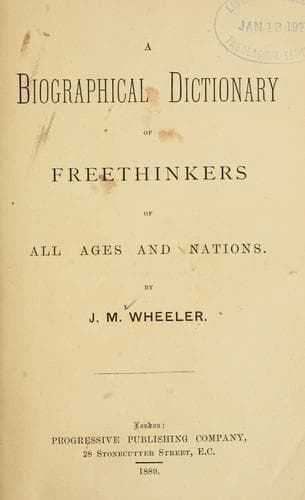
A Biographical Dictionary of Freethinkers of All Ages and NationsWheeler, J. M. (Joseph Mazzini)
Religion
A Biographical Dictionary of Freethinkers of All Ages and Nations
Wheeler, J. M. (Joseph Mazzini)
Free thought -- Biography
Mongez (Antoine), French archæologist, b. Lyons, 30 June
1747. Distinguished by his studies, he became a member of the Academy
of Inscriptions and of the Institute, before which he said "he had
the honor to be an Atheist." He was one of the most ardent members of
the Convention, and wrote many memoirs. Died at Paris, 30 July, 1835.
Monroe (J. R.), Dr., editor and proprietor of the Ironclad Age,
b. Monmouth, co. New Jersey, about 1825. In '50 he went to Rochford,
where he had a good practice as a doctor. In '55 he started the
Rochford Herald, and in July, '57, the Seymour Times. During the Civil
War he was appointed surgeon to the 150th regiment, and after some
hard service his own health broke down. In '75 Dr. Monroe published
his dramas and poems in a volume. From this time his paper became
more Freethought and less political. In April, '82, he removed to
Indianapolis, Indiana, and changed the name to The Age, afterwards
Monroe's Ironclad Age. Dr. Monroe is a clever writer and a modest man,
with a remarkable fund of natural humor. Among his publications are
poems on The Origin of Man, etc., Genesis Revised, and Holy Bible
Stories.
Montaigne (Michel de), French philosophic essayist, b. at the family
castle in Perigord, 28 Feb. 1533. He studied law and became a judge
at Bordeaux about 1554. In 1580 he produced his famous "Essays,"
which indicate a sprightly humor allied to a most independent
spirit. The Essays, Hallam says, make in several respects an epoch in
literature. Emerson says, "Montaigne is the frankest and honestest
of all writers." Montaigne took as his motto: Que sçais-je? [What
know I?] and said that all religious opinions are the result of
custom. Buckle says, "Under the guise of a mere man of the world,
expressing natural thoughts in common language, Montaigne concealed a
spirit of lofty and audacious inquiry." Montaigne seems to have been
the first man in Europe who doubted the sense and justice of burning
people for a difference of opinion. His denunciation of the conduct of
the Christians in America does him infinite honor. Died 13 Sept. 1592.
Monteil (Charles François Louis Edgar), French journalist, b. Vire,
26 Jan. 1845. Fought against the Empire, writing in Le Rappel. During
the Commune he was secretary to Delescluze. For his Histoire d'un
Frère Ignorantin, '74, he was prosecuted by the Christian Brothers,
and condemned to one year's imprisonment, 2,000 francs fine, and 10,000
francs damages. In '77 he wrote a Freethinker's Catechism, published
at Antwerp, and in '79 an edition of La République Française. In '80
he was made a member of the Municipal Council of Paris, and re-elected
in '84. In '83 he was made Chevalier of the Legion of Honor. He has
compiled an excellent secular Manual of Instruction for schools.
Public-domain text, read in full here on John Shaqi.
Reviews
Reviews
No reviews yet
Be the first to share your thoughts on this work.
Elsewhere in the archive
Join the Discussion
Join the discussion
Sign in to leave a comment or review.
Sign InorCreate an account