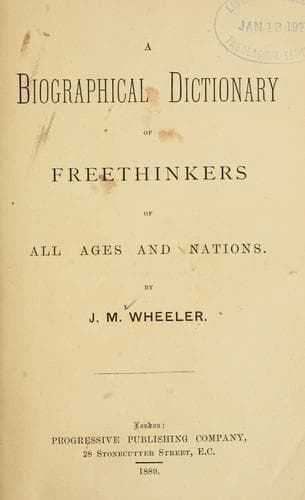
A Biographical Dictionary of Freethinkers of All Ages and NationsWheeler, J. M. (Joseph Mazzini)
Religion
A Biographical Dictionary of Freethinkers of All Ages and Nations
Wheeler, J. M. (Joseph Mazzini)
Free thought -- Biography
Passerano (Alberto Radicati di) count. Italian philosopher of last
century, attached to the court of Victor Amedée II. For some pamphlets
written against the Papal power he was pursued by the Inquisition and
his goods seized. He lived in England and made the acquaintance of
Collins, also in France and Holland, where he died about 1736, leaving
his goods to the poor. In that year he published at Rotterdam Recueil
de Pièces curieuses sur les matieres les plus íntéressantes, etc.,
which contains a Parallel between Mahomet and Sosem (anagram of Moses),
an abridged history of the Sacerdotal Profession, and a Faithful and
comic recital of the religion of modern cannibals, by Zelin Moslem;
also a Dissertation upon Death, which was published separately in
1733. The Recueil was republished at London in 1749. He also wrote a
pretended translation from an Arabic work on Mohammedanism, satirising
the Bible, and a pretended sermon by Elwall the Quaker.
Pasteur (Louis). French scientist b. Dôle, 27 Dec 1822, became doctor
in '47 and professor of physic at Strassburg in '48. He received
the Rumford medal of the Royal Society in '56 for his discoveries
in polarisation and molecular chemistry. Decorated with the Legion
of honor in '53, he was made commander '68 and grand officer '78. His
researches into innoculation have been much contested, but his admirers
have raised a large institute for the prosecution of his treatment. He
was elected to the Academy as successor of Littré. He gave his name
as Vice-President of the British Secular Union.
Pastoret (Claude Emmanuel Joseph Pierre de), Marquis, French statesman
and writer, b. of noble family at Marseilles, 25 Oct. 1756. Educated by
the Oratorians at Lyons, in 1779 he published an Elege de Voltaire. By
his works on Zoroaster, Confucius and Mahomet (1787) and on Moses
Considered as Legislator and Moralist (1788) he did something for the
infant science of comparative religion. His principal work is a learned
History of Legislation, in 11 vols. (1817-37), in which he passes in
review all the ancient codes. He embraced the Revolution, and became
President of the Legislative Assembly (3 Oct. 1791). He proposed the
erection of the Column of July on the Place of the Bastille, and the
conversion of the church of Ste Geneviève into the Pantheon. On the
19th June, 1792, he presented a motion for the complete separation of
the state from religion. He fled during the Terror, but returned as
deputy in 1795. In 1820 he succeeded his friend Volney as member of
the French Academy, in '23 received the cross of the Legion of Honor,
and in '29 became Chancellor of France. Died at Paris, 28 Sept. 1840.
Pater (Walter Horatio), English writer, b. London, 4 Aug. 1839. B.A. at
Oxford in '62, M.A. in '65. Has written charming essays in the
Westminster Review, Macmillan, and the Fortnightly Review. In '73
he published The Renaissance, and in '85 Marius the Epicurean, His
Sensations and Ideas.
Public-domain text, read in full here on John Shaqi.
Reviews
Reviews
No reviews yet
Be the first to share your thoughts on this work.
Elsewhere in the archive
Join the Discussion
Join the discussion
Sign in to leave a comment or review.
Sign InorCreate an account