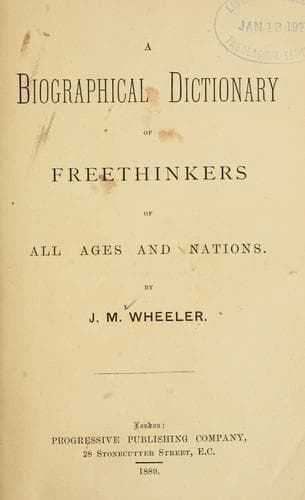
A Biographical Dictionary of Freethinkers of All Ages and NationsWheeler, J. M. (Joseph Mazzini)
Religion
A Biographical Dictionary of Freethinkers of All Ages and Nations
Wheeler, J. M. (Joseph Mazzini)
Free thought -- Biography
Paterson (Thomas), b. near Lanark early in this century. After
the imprisonment of Southwell and Holyoake he edited the Oracle of
Reason. For exhibiting profane placards he was arrested and sentenced
27 Jan. 1843 to three months' imprisonment. His trial was reported
under the title God v. Paterson ('43.) He insisted on considering
God as the plaintiff and in quoting from "the Jew book" to show
the plaintiff's bad character. When released he went to Scotland to
uphold the right of free publication, and was sentenced 8 Nov. '43 to
fifteen months' imprisonment for selling "blasphemous" publications
at Edinburgh. On his release he was presented with a testimonial 6
April, 1845, H. Hetherington presiding. Paterson went to America.
Patin (Gui), French physician, writer, and wit, b. near Beauvais
31 Aug. 1602. He became professor at the college of France. His
reputation is chiefly founded on his Letters, in which he attacked
superstition. Larousse says "C'était un libre penseur de la famille
de Rabelais." Died at Paris 30 Aug. 1672.
Patot. See Tyssot de Patot (S.)
Pauw (Cornelius), learned Dutch writer, b. Amsterdam, 1739. He wrote
philosophical researches on the Americans, and also on the Egyptians,
Chinese, and Greeks. Was esteemed by Frederick the Great for his
ingenuity and penetration. Died at Xanten, 7 July, 1799. He was the
uncle of Anacharsis Clootz.
Peacock (John Macleay), Scotch poet, b. 21 March, 1817. He wrote
many poems in the National Reformer, and in '67 published Hours of
Reverie. Died 4 May, 1877.
Peacock or Pecock (Reginald), the father of English rationalism,
b. about 1390, and educated at Oriel College Oxford, of which he
was chosen fellow in 1417. Was successively Bishop of St Asaph,
1444, and Chichester, 1450, by the favor of Humphrey, the good
Duke of Gloster. He declared that Scripture must in all cases be
accommodated to "the doom of reason." He questioned the genuineness
of the Apostles' Creed. In 1457 he was accused of heresy, recanted
from fear of martyrdom, was deprived of his bishopric, and imprisoned
in a monastery at Canterbury, where he used to repeat to those who
visited him,
"Wit hath wonder, that reason cannot skan,
How a Moder is Mayd, and God is Man."
His books were publicly burnt at Oxford. He died in 1460. His influence
doubtless contributed to the Reformation.
Pearson (Karl), author of a volume of essays entitled The Ethic of
Freethought, 1888. Educated at Cambridge; B.A. '79, M.A. '82.
Pechmeja (Jean de), French writer. A friend of Raynal, he wrote a
socialistic romance in 12 books in the style of Telemachus, called
Télèphe, 1784. Died 1785.
Peck (John), American writer in the Truthseeker. Has published Miracles
and Miracle Workers, etc.
Pecqueur (A.), contributor to the Rationaliste of Geneva, 1864.
Pelin (Gabriel), French author of works on Spiritism Explained and
Destroyed, 1864, and God or Science, '67.
Public-domain text, read in full here on John Shaqi.
Reviews
Reviews
No reviews yet
Be the first to share your thoughts on this work.
Elsewhere in the archive
Join the Discussion
Join the discussion
Sign in to leave a comment or review.
Sign InorCreate an account