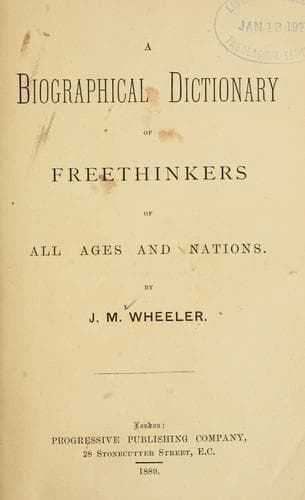
A Biographical Dictionary of Freethinkers of All Ages and NationsWheeler, J. M. (Joseph Mazzini)
Religion
A Biographical Dictionary of Freethinkers of All Ages and Nations
Wheeler, J. M. (Joseph Mazzini)
Free thought -- Biography
Pitt (William). Earl of Chatham, an illustrious English statesman
and orator, b. Boconnoc, Cornwall, 15 Nov. 1708. The services to his
country of "the Great Commoner," as he was called, are well known,
but it is not so generally recognised that his Letter on Superstition,
first printed in the London Journal in 1733, entitles him to be ranked
with the Deists. He says that "the more superstitious people are,
always the more vicious; and the more they believe, the less they
practice." Atheism furnishes no man with arguments to be vicious;
but superstition, or what the world made by religion, is the greatest
possible encouragement to vice, by setting up something as religion,
which shall atone and commute for the want of virtue. This remarkable
letter ends with the words "Remember that the only true divinity
is humanity."
Place (Francis), English Radical reformer and tailor; b. 1779 at
Charing Cross. He early became a member of the London, Corresponding
Society. He wrote to Carlile's Republican and Lion. A friend of
T. Hardy, H. Tooke, James Mill, Bentham, Roebuck, Hetherington, and
Hibbert (who puts him in his list of English Freethinkers). He was
connected with all the advanced movements of his time and has left
many manuscripts illustrating the politics of that period, which are
now in the British Museum. He always professed to be an Atheist--see
Reasoner, 26 March, '54. Died at Kensington, 1 Jan. 1854.
Platt (James), F.S.S., a woolen merchant and Deistic author of
popular works on Business, '75; Morality, '78; Progress, '80; Life,
'81; God and Mammon, etc.
Pliny (Caius Plinius Secundus), the elder, Roman naturalist, b. Verona,
A.D. 22. He distinguished himself in the army, was admitted into the
college of Augurs, appointed procurator in Spain, and honored with
the esteem of Vespasian and Titus. He wrote the history of his own
time in 31 books, now lost, and a Natural History in 37 books, one
of the most precious monuments of antiquity, in which his Epicurean
Atheism appears. Being with the fleet at Misenum, 24 Aug. A.D. 79,
he observed the eruption of Mount Vesuvius, and landing to assist
the inhabitants was himself suffocated by the noxious vapors.
Plumacher (Olga), German pessimist, follower of Hartmann, and authoress
of a work on Pessimism in the Past and Future, Heidelberg, 1884. She
has also defended her views in Mind.
Plumer (William) American senator, b. Newburyport, Mass. 25 June,
1759. In 1780 he became a Baptist preacher, but resigned on account
of scepticism. He remained a deist. He served in the Legislature
eight terms, during two of which he was Speaker. He was governor
of New Hampshire, 1812-18, wrote to the press over the signature
"Cincinnatus," and published an Address to the Clergy, '14. He lived
till 22 June, 1850.
Public-domain text, read in full here on John Shaqi.
Reviews
Reviews
No reviews yet
Be the first to share your thoughts on this work.
Elsewhere in the archive
Join the Discussion
Join the discussion
Sign in to leave a comment or review.
Sign InorCreate an account