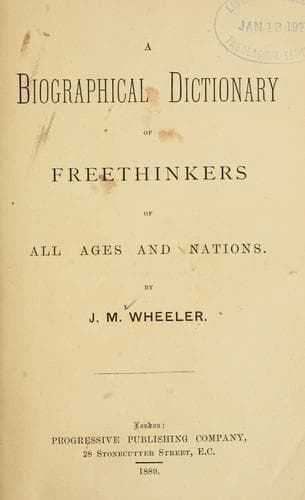
A Biographical Dictionary of Freethinkers of All Ages and NationsWheeler, J. M. (Joseph Mazzini)
Religion
A Biographical Dictionary of Freethinkers of All Ages and Nations
Wheeler, J. M. (Joseph Mazzini)
Free thought -- Biography
Plutarch. Greek philosopher and historian, b. Cheronæa in Boetia, about
A.D. 50. He visited Delphi and Rome, where he lived in the reign of
Trajan. His Parallel Lives of forty-six Greeks and Romans have made
him immortal. He wrote numerous other anecdotal and ethical works,
including a treatise on Superstition. He condemned the vulgar notions
of Deity, and remarked, in connection with the deeds popularly ascribed
to the gods, that he would rather men said there was no Plutarch than
traduce his character. In other words, superstition is more impious
than Atheism. Died about A.D. 120.
Poe (Edgar Allan), American poet, grandson of General Poe, who figured
in the war of independence, b. Boston, 19 Jan. 1809. His mother was
an actress. Early left an orphan. After publishing Tamerlane and other
Poems, '27, he enlisted in the United States Army, but was cashiered in
'31. He then took to literary employment in Baltimore and wrote many
stories, collected as the Tales of Mystery, Imagination, and Humor. In
'45 appeared The Raven and other Poems, which proved him the most
musical and dextrous of American poets. In '48 he published Eureka,
a Prose Poem, which, though comparatively little known, he esteemed
his greatest work. It indicates pantheistic views of the universe. His
personal appearance was striking and one of his portraits is not
unlike that of James Thomson. Died in Baltimore, 7 Oct. 1849.
Poey (Andrés), Cuban meteorologist and Positivist of French and Spanish
descent, b. Havana, 1826. Wrote in the Modern Thinker, and is author
of many scientific memoirs and a popular exposition of Positivism
(Paris, 1876), in which he has a chapter on Darwinism and Comtism.
Pompery (Edouard), French publicist, b. Courcelles, 1812. A follower
of Fourier, he has written on Blanquism and opportunism, '79, and a
Life of Voltaire, '80.
Pomponazzi (Pietro) [Lat. Pomponatius], Italian philosopher,
b. Mantua, of noble family, 16 Sept. 1462. He studied at Padua,
where he graduated 1487 as laureate of medicine. Next year he was
appointed professor of philosophy at Padua, teaching in concurrence
with Achillini. He afterwards taught the doctrines of Aristotle at
Ferrara and Bologna. His treatise De Immortalitate Animæ, 1516, gave
great offence by denying the philosophical foundation of the doctrine
of the immortality of the soul. The work was burnt by the hangman at
Venice, and it is said Cardinal Bembo's intercession with Pope Leo
X. only saved Pomponazzi from ecclesiastical procedure. Among his works
is a treatise on Fate, Free Will, etc. Pomponazzi was a diminutive
man, and was nicknamed "Peretto." He held that doubt was necessary
for the development of knowledge, and left an unsullied reputation
for upright conduct and sweet temper. Died at Bologna, 18 May, 1525,
and was buried at Mantua, where a monument was erected to his memory.
Public-domain text, read in full here on John Shaqi.
Reviews
Reviews
No reviews yet
Be the first to share your thoughts on this work.
Elsewhere in the archive
Join the Discussion
Join the discussion
Sign in to leave a comment or review.
Sign InorCreate an account