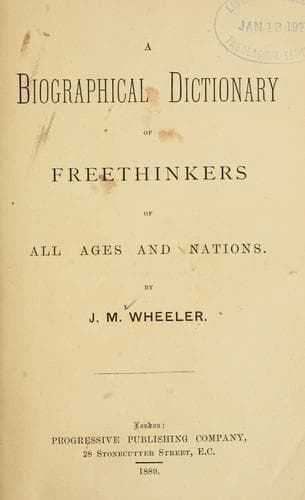
A Biographical Dictionary of Freethinkers of All Ages and NationsWheeler, J. M. (Joseph Mazzini)
Religion
A Biographical Dictionary of Freethinkers of All Ages and Nations
Wheeler, J. M. (Joseph Mazzini)
Free thought -- Biography
Prades (Jean Martin de), French theologian b. Castel-Sarrasin, about
1720. Brought up for the church, he nevertheless became intimate with
Diderot and contributed the article Certitude to the Encyclopédie. On
the 18th Nov. 1751 he presented to the Sorbonne a thesis for the
doctorate, remarkable as the first open attack on Christianity by
a French theologian. He maintained many propositions on the soul,
the origin of society, the laws of Moses, miracles, etc., contrary
to the dogmas of the Church, and compared the cures recorded in the
Gospels to those attributed to Esculapius. The thesis made a great
scandal. His opinions were condemned by Pope Benedict XIV., and he
fled to Holland for safety. Recommended to Frederick the Great by
d'Alembert he was received with favor at Berlin, and became reader to
that monarch, who wrote a very anti-Christian preface to de Prades'
work on ecclesiastical history, published as Abrége de l'Histoire
ecclesiastique de Fleury, Berne (Berlin) 1766. He retired to a benefice
at Glogau (Silesia), given him by Frederick, and died there in 1782.
Prater (Horatio), a gentleman of some fortune who devoted himself to
the propagation of Freethought ideas. Born early in the century, he
wrote on the Physiology of the Blood, 1832. He published Letters to
the American People, and Literary Essays, '56. Died 20 July, 1885. He
left the bulk of his money to benevolent objects, and ordered a deep
wound to be made in his arm to insure that he was dead.
Preda (Pietro), Italian writer of Milan, author of a work on Revelation
and Reason, published at Geneva, 1865, under the pseudonym of
"Padre Pietro."
Premontval (Andre Pierre Le Guay de), French writer, b. Charenton, 16
Feb. 1716. At nineteen years of age, while in the college of Plessis
Sorbonne, he composed a work against the dogma of the Eucharist. He
studied mathematics and became member of the Academy of Sciences
at Berlin. He wrote Le Diogene de D'Alembert, or Freethoughts on
Man, 1754, Panangiana Panurgica, or the false Evangelist, and Vues
Philosophiques, Amst., 2 vols., 1757. He also wrote De la Théologie
de L'Etre, in which he denies many of the ordinary proofs of the
existence of a God. Died Berlin, 1767.
Public-domain text, read in full here on John Shaqi.
Reviews
Reviews
No reviews yet
Be the first to share your thoughts on this work.
Elsewhere in the archive
Join the Discussion
Join the discussion
Sign in to leave a comment or review.
Sign InorCreate an account