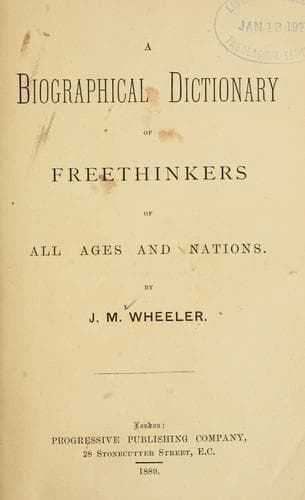
A Biographical Dictionary of Freethinkers of All Ages and NationsWheeler, J. M. (Joseph Mazzini)
Religion
A Biographical Dictionary of Freethinkers of All Ages and Nations
Wheeler, J. M. (Joseph Mazzini)
Free thought -- Biography
Priestley (Joseph), LL.D., English philosopher, b. Fieldhead, near
Leeds, 18 March, 1733. Brought up as a Calvinist, he found his way
to broad Unitarianism. Famous as a pneumatic chemist, he defended the
doctrine of philosophical necessity, and in a dissertation annexed to
his edition of Hartley expressed doubts of the immateriality of the
sentient principal in man. This doctrine he forcibly supported in
his Disquisitions on Matter and Spirit, 1777. Through the obloquy
these works produced, he lost his position as librarian to Lord
Shelburne. He then removed to Birmingham, and became minister of
an independent Unitarian congregation, and occupied himself on his
History of the Corruptions of Christianity and History of the Early
Opinions Concerning Jesus Christ, which involved him in controversy
with Bishop Horsley and others. In consequence of his sympathy with
the French Revolution, his house was burnt and sacked in a riot,
14 July, 1791. After this he removed to Hackney, and was finally
goaded to seek an asylum in the United States, which he reached in
1794. Even in America he endured some uneasiness on account of his
opinions until Jefferson became president. Died 6 Feb. 1804.
Pringle (Allen), Canadian Freethinker, author of Ingersoll in Canada,
1880.
Proctor (Richard Anthony), English astronomer, b. Chelsea, 23 March,
1837. Educated at King's College, London, and at St. John's, Cambridge,
where he became B.A. in '60. In '66 he became Fellow of the Royal
Astronomical Society, of which he afterwards became hon. sec. He
maintained in '69 the since-established theory of the solar corona. He
wrote, lectured, and edited, far and wide, and left nearly fifty
volumes, chiefly popularising science. Attracted by Newman, he was for
a while a Catholic, but thought out the question of Catholicism and
science, and in a letter to the New York Tribune, Nov. '75, formally
renounced that religion as irreconcilable with scientific facts. His
remarks on the so-called Star of Bethlehem in The Universe of Suns,
and other Science Gleanings, and his Sunday lectures, indicated his
heresy. In '81 he started Knowledge, in which appeared many valuable
papers, notably one (Jan. '87), "The Beginning of Christianity." He
entirely rejected the miraculous elements of the gospels, which he
considered largely a rechauffé of solar myths. In other articles
in the Freethinkers' Magazine and the Open Court he pointed out the
coincidence between the Christian stories and solar myths, and also
with stories found in Josephus. The very last article he published
before his untimely death was a vindication of Colonel Ingersoll
in his controversy with Gladstone in the North American Review. In
'84 he settled at St. Josephs, Mobille, where he contracted yellow
fever and died at New York, 12 Sep. 1888.
Public-domain text, read in full here on John Shaqi.
Reviews
Reviews
No reviews yet
Be the first to share your thoughts on this work.
Elsewhere in the archive
Join the Discussion
Join the discussion
Sign in to leave a comment or review.
Sign InorCreate an account