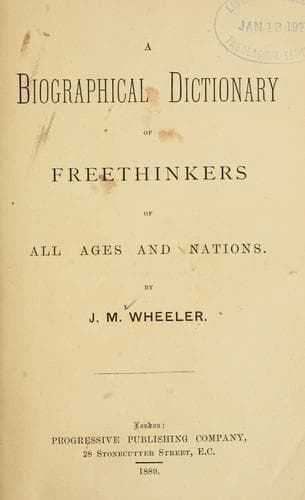
A Biographical Dictionary of Freethinkers of All Ages and NationsWheeler, J. M. (Joseph Mazzini)
Religion
A Biographical Dictionary of Freethinkers of All Ages and Nations
Wheeler, J. M. (Joseph Mazzini)
Free thought -- Biography
Proudhon (Pierre Joseph), French anarchist and political thinker,
b. Besançon, 15 Jan. 1809. Self-educated he became a printer,
and won a prize of 1,500 francs for the person "best fitted for a
literary or scientific career." In '40 appears his memoir, What is
Property? in which he made the celebrated answer "C'est le vol." In
'43 the Creation of Order in Humanity appeared, treating of religion,
philosophy and logic. In '46 he published his System of Economical
Contradictions, in which appeared his famous aphorism, "Dieu,
c'est le mal." In '48 he introduced his scheme of the organisation
of credit in a Bank of the People, which failed, though Proudhon
saw that no one lost anything. He attacked Louis Bonaparte when
President, and was sentenced to three years' imprisonment and a fine
of 10,000 francs. On 2 Jan. '50 he married by private contract while
in prison. For his work on Justice in the Revolution and in the Church
he was condemned to three years' imprisonment and 4,000 francs fine in
'58. He took refuge in Belgium and returned in '63. Died at Passy,
19 Jan. 1865. Among his posthumous works was The Gospels Annotated,
'66. Proudhon was a bold and profound thinker of noble aspirations,
but he lacked the sense of art and practicability. His complete works
have been published in 26 vols.
Protagoras, Greek philosopher, b. Abdera, about 480 B.C. Is said to
have been a disciple of Democritus, and to have been a porter before
he studied philosophy. He was the first to call himself a sophist. He
wrote in a book on the gods, "Respecting the gods, I am unable to
know whether they exist or do not exist." For this he was impeached
and banished, and his book burnt. He went to Epirus and the Greek
Islands, and died about 411. He believed all things were in flux,
and summed up his conclusions in the proposition that "man is the
measure of all things, both of that which exists and that which does
not exist." Grote, who defends the Sophists, says his philosophy "had
the merit of bringing into forcible relief the essentially relative
nature of cognition."
Prudhomme (Sully). See Sully Prudhomme.
Pückler Muskau (Hermann Ludwig Heinrich), Prince, a German writer,
b. Muskau, 30 Oct. 1785. He travelled widely and wrote his observations
in a work entitled Letters of a Defunct, 1830; this was followed by
Tutti Frutti, '32; Semilasso in Africa, '36, and other works. Died
4 Feb. 1871.
Public-domain text, read in full here on John Shaqi.
Reviews
Reviews
No reviews yet
Be the first to share your thoughts on this work.
Elsewhere in the archive
Join the Discussion
Join the discussion
Sign in to leave a comment or review.
Sign InorCreate an account