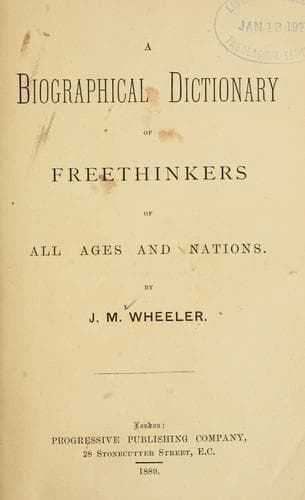
A Biographical Dictionary of Freethinkers of All Ages and NationsWheeler, J. M. (Joseph Mazzini)
Religion
A Biographical Dictionary of Freethinkers of All Ages and Nations
Wheeler, J. M. (Joseph Mazzini)
Free thought -- Biography
Taurellus (Nicolaus), German physician and philosopher, b. Montbéhard,
26 Nov. 1547, studied medicine at Tübingen and Basle. For daring to
think for himself, and asking how the Aristotelian doctrine of the
eternity of the world could be reconciled with the dogma of creation,
he was stigmatised as an atheist. Wrote many works in Latin, the
principal of which is Philosophiæ Triumphans, 1573. He died of the
plague 28 Sept. 1606.
Taylor (Robert), ex-minister, orator, and critic, b. Edmonton,
18 Aug. 1784. In 1805 he walked Guy's and St. Thomas's Hospital,
and became M.R.C.S., 1807. Persuaded to join the Church, he entered
St. John's, Cambridge, Oct. 1809, in Jan. '13 graduated B.A., and
soon after took holy orders. He was curate at Midhurst till '18, when
he first became sceptical through discussions with a tradesman. He
preached a sermon on Jonah which astonished his flock, and resigned. He
then went to Dublin and published The Clerical Review and started
"The Society of Universal Benevolence." In '24 he came to London and
started "The Christian Evidence Society," and delivered discourses with
discussion; also edited the Philalethian. In '27 he was indicted for
blasphemy, tried Oct. 24, after an able defence he was found guilty,
and on 7 Feb. '28 sentenced to one year's imprisonment in Oakham
Gaol. Here he wrote his Syntagma on the Evidences of Christianity,
and his chief work, The Diegesis, being a discovery of the origins,
evidences, and early history of Christianity. He also contributed a
weekly letter to The Lion, which R. Carlile started on his behalf. On
his liberation they both went on "an infidel mission" about the
country, and on May 30 the Rotunda, Blackfriars, was taken, where
Taylor attired in canonicals delivered the discourses published in
The Devil's Pulpit. He was again prosecuted, and on 4 July, '31, was
sentenced to two year's imprisonment. He was badly treated in gaol,
and soon after coming out married a wealthy lady and retired. Died
at Jersey, 5 June, 1844.
Taylor (Thomas), known as "The Platonist," b. London, 1758. He
devoted his life to the elucidation and propagation of the Platonic
philosophy. He translated the works of Plato, Aristotle, Porphyry, five
books of Plotinus, six books of Proclus, Gamblichus on the Mysteries,
Arguments of Celsus taken from Origen, Arguments of Julian against
the Christians, Orations of Julian, etc. He is said to have been so
thorough a Pagan that he sacrificed a bull to Zeus. Died in Walworth,
1 Nov. 1835.
Public-domain text, read in full here on John Shaqi.
Reviews
Reviews
No reviews yet
Be the first to share your thoughts on this work.
Elsewhere in the archive
Join the Discussion
Join the discussion
Sign in to leave a comment or review.
Sign InorCreate an account