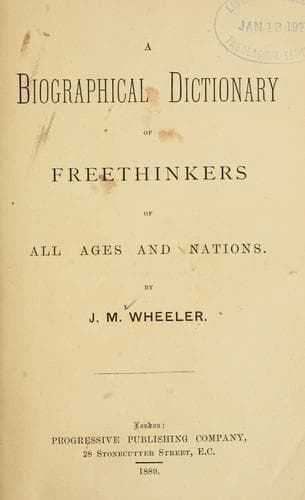
A Biographical Dictionary of Freethinkers of All Ages and NationsWheeler, J. M. (Joseph Mazzini)
Religion
A Biographical Dictionary of Freethinkers of All Ages and Nations
Wheeler, J. M. (Joseph Mazzini)
Free thought -- Biography
Taylor (William), of Norwich, b. 7 Nov. 1765. He formed an acquaintance
with Southey, with whom he corresponded. His translations from
the German, notably Lessing's Nathan the Wise, brought him some
repute. He also wrote a Survey of German Poetry and English Synonyms,
1830. He edited the Norwich Iris, 1802, which he made the organ of his
political and religions views. In '10 he published anonymously A Letter
Concerning the Two First Chapters of Luke, also entitled Who was the
Father of Jesus Christ? 1810, in which he argues that Zacharias was
the father of Jesus Christ. Also wrote largely in the Monthly Review,
replying therein to the Abbé Barruel; and the Critical Review when
edited by Fellowes, in which he gave an account of the rationalism
of Paulus. Died at Norwich, 5 March, 1836.
Tchernychewsky (N. G.) See Chernuishevsky.
"Tela (Josephus)," the Latinised name of Joseph Webbe who in 1818
edited the Philosophical Library, containing the Life and Morals of
Confucius, Epicurus, Isoscrates, Mahomet, etc., and other pieces. Webbe
is also thought to have been concerned in the production of Ecce Homo,
'13. Cushing, in his Initials and Pseudonyms, refers Tela to "Joseph
Webb," 1735-87; an American writer; Grand Master of Freemasons in
America; died in Boston." I am not satisfied that this is the same
person.
Telesio (Bernardino), Italian philosopher, b. of noble family at
Cosenza, 1509. He studied at Padua, and became famous for his learning,
optical discoveries, and new opinions in philosophy. He wrote in
Latin On the Nature of Things according to Proper Principles, 1565. He
opposed the Aristotelian doctrine in physics, and employed mathematical
principles in explaining nature, for which he was prosecuted by the
clergy. He died Oct. 1588. His works were placed in the Index, but
this did not prevent their publication at Venice, 1590.
Telle (Reinier), or Regnerus Vitellius, Dutch Humanist, b. Zierikzee,
1578. He translated Servetus On the Errors of the Trinity, published
1620. Died at Amsterdam, 1618.
Testa (Giacinto), of Messina, Italian author of a curious Storia di
Gesù di Nazareth, 1870, in which he maintains that Jesus was the son
of Giuseppe Pandera, a Calabrian of Brindisi.
Thaer (Albrecht Daniel). German agriculturist, b. Celle, 14 May,
1752. Studied at Gottingen, and is said to have inspired Lessing's
work on The Education of the Human Race. Died 28 Oct. 1828.
Theodorus of Cyrene, a Greek philosopher, whose opinions resembled
those of Epicurus. He was banished for Atheism from his native city. He
resided at Athens about 312 B.C. When threatened with crucifixion, he
said it mattered little whether he rotted in the ground or in the air.
Theophile de Viau, French satiric poet, b. Clerac, 1590. For the
alleged publication of Le Parnasse Satyriques, he was accused of
Atheism, condemned to death, and burnt in effigy. He fled, and was
received by the Duc de Montmorency at Chantilly, where he died,
25 Sept. 1626.
Public-domain text, read in full here on John Shaqi.
Reviews
Reviews
No reviews yet
Be the first to share your thoughts on this work.
Elsewhere in the archive
Join the Discussion
Join the discussion
Sign in to leave a comment or review.
Sign InorCreate an account