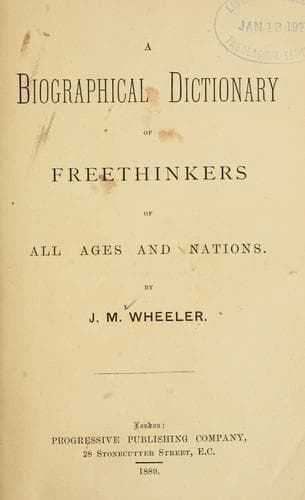
A Biographical Dictionary of Freethinkers of All Ages and Nations — John Shaqi
A Biographical Dictionary of Freethinkers of All Ages and NationsWheeler, J. M. (Joseph Mazzini)
Religion
A Biographical Dictionary of Freethinkers of All Ages and Nations
Wheeler, J. M. (Joseph Mazzini)
Free thought -- Biography
Beesly (Edward Spencer), Positivist, b. Feckenham, Worcestershire,
1831. Educated at Wadham College, Oxford, where he took B.A. in 1854,
and M.A. in '57. Appointed Professor of History, University College,
London, in 1860. He is one of the translators of Comte's System of
Positive Polity, and has published several pamphlets on political
and social questions.
Beethoven (Ludwig van), one of the greatest of musical composers,
b. Bonn 16 Dec. 1770. His genius early displayed itself, and at the
age of five he was set to study the works of Handel and Bach. His many
compositions are the glory of music. They include an opera "Fidelio,"
two masses, oratorios, symphonies, concertos, overtures and sonatas,
and are characterised by penetrating power, rich imagination, intense
passion, and tenderness. When about the age of forty he became totally
deaf, but continued to compose till his death at Vienna, 26 March,
1827. He regarded Goethe with much the same esteem as Wagner showed
for Schopenhauer, but he disliked his courtliness. His Republican
sentiments are well known, and Sir George Macfarren, in his life in
the Imperial Dictionary of Universal Biography, speaks of him as a
"Freethinker," and says the remarkable mass in C. "might scarcely
have proceeded from an entirely orthodox thinker." Sir George Grove,
in his Dictionary of Music and Musicians, says: "Formal religion he
apparently had none," and "the Bible does not appear to have been one
of his favorite books." At the end of his arrangement of "Fidelio"
Moscheles had written, "Fine. With God's help." To this Beethoven
added, "O man, help thyself."
Bekker (Balthasar), Dutch Rationalist, b. Metslawier (Friesland)
20 March, 1634. He studied at Gronigen, became a doctor of divinity,
and lived at Francker, but was accused of Socinianism, and had to fly
to Amsterdam, where he raised another storm by his World Bewitched
(1691), a work in which witchcraft and the power of demons are
denied. His book, which contains much curious information, raised
a host of adversaries, and he was deposed from his place in the
Church. It appeared in English in 1695. Died, Amsterdam, 11 June,
1698. Bekker was remarkably ugly, and he is said to have "looked like
the devil, though he did not believe in him."
Belinsky (Vissarion Grigorevich), Russian critic, b. Pensa 1811,
educated at Pensa and Moscow, adopted the Pantheistic philosophy of
Hegel and Schelling. Died St. Petersburg, 28 May, 1848. His works
were issued in 12 volumes, 1857-61.
Public-domain text, read in full here on John Shaqi.
Reviews
Reviews
No reviews yet
Be the first to share your thoughts on this work.
Join the Discussion
Join the discussion
Sign in to leave a comment or review.
Sign InorCreate an account