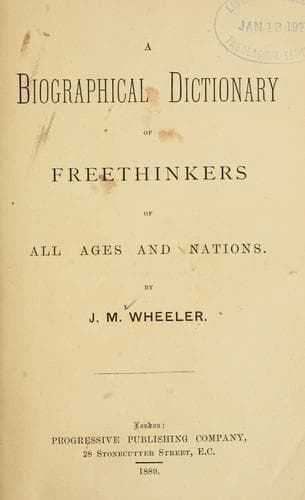
A Biographical Dictionary of Freethinkers of All Ages and NationsWheeler, J. M. (Joseph Mazzini)
Religion
A Biographical Dictionary of Freethinkers of All Ages and Nations
Wheeler, J. M. (Joseph Mazzini)
Free thought -- Biography
Berkenhout (Dr. John), physician and miscellaneous writer, b. 1731,
the son of a Dutch merchant who settled at Leeds. In early life he
had been a captain both in the Prussian and English service, and
in 1765 took his M.D. degree at Leyden. He published many books on
medical science, a synopsis of the natural history of Great Britain
and Ireland, and several humorous pieces, anonymously. His principal
work is entitled Biographia Literaria, a biographical history of
English literature, 1777. Throughout the work he loses no opportunity
of displaying his hostility to the theologians, and is loud in his
praises of Voltaire. Died 3 April, 1791.
Berlioz (Louis Hector). The most original of French musical composers,
b. Isère, 11 Dec. 1803. He obtained fame by his dramatic symphony
of Romeo and Juliet (1839), and was made chevalier of the Legion
of Honor. Among his works is one on the Infancy of Christ. In his
Memoirs he relates how he scandalised Mendelssohn "by laughing at
the Bible." Died Paris, 9 March, 1869.
Bernard (Claude), French physiologist, b. Saint Julien 12 July,
1813. Went to Paris 1832, studied medicine, became member of the
Institute and professor at the Museum of Natural History, wrote
La Science Experimentale, and other works on physiology. Died 10
Feb. 1878, and was buried at the expense of the Republic. Paul Bert
calls him the introducer of determinism in the domain of physiology.
Bernier (Abbé). See Holbach.
Bernier (François), French physician and traveller, b. Angers about
1625. He was a pupil of Gassendi, whose works he abridged, and he
defended Descartes against the theologians. He is known as le joli
philsophe. In 1654 he went to Syria and Egypt, and from thence to
India, where he became physician to Aurungzebe. On his return he
published an account of his travels and of the Empire of the Great
Mogul, and died at Paris 22 Sept. 1688.
Bernstein (Aaron), a rationalist, b. of Jewish parents Dantzic
1812. His first work was a translation of the Song of Songs, published
under the pseudonym of A. Rebenstein (1834). He devoted himself
to natural science and published works on The Rotation of Planets,
Humboldt and the Spirit of the Time, etc. His essay on The Origin of
the Legends of Abraham, Isaac, and Jacob was translated by a German
lady and published by Thomas Scott of Ramsgate (1872). Died Berlin,
12 Feb. 1884.
Berquin (Louis de), French martyr, b. in Artois, 1489. Erasmus,
his friend, says his great crime was openly professing hatred of
the monks. In 1523 his works were ordered to be burnt, and he was
commanded to abjure his heresies. Sentence of perpetual banishment
was pronounced on him on April 16, 1529. He immediately appealed to
the Parliament. His appeal was heard and rejected on the morning of
the 17th. The Parliament reformed the judgment and condemned him to
be burnt alive, and the sentence was carried out on the same afternoon
at the Place de la Grève. He died with great constancy and resolution.
Public-domain text, read in full here on John Shaqi.
Reviews
Reviews
No reviews yet
Be the first to share your thoughts on this work.
Join the Discussion
Join the discussion
Sign in to leave a comment or review.
Sign InorCreate an account