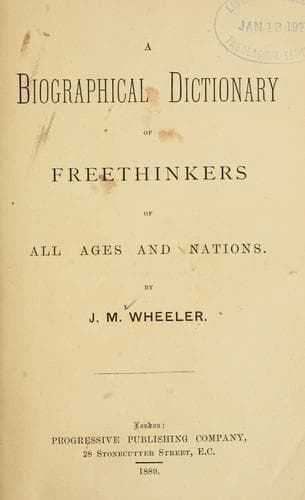
A Biographical Dictionary of Freethinkers of All Ages and Nations — John Shaqi
A Biographical Dictionary of Freethinkers of All Ages and NationsWheeler, J. M. (Joseph Mazzini)
Religion
A Biographical Dictionary of Freethinkers of All Ages and Nations
Wheeler, J. M. (Joseph Mazzini)
Free thought -- Biography
Beverland (Hadrianus), Dutch classical scholar and nephew of Isaac
Vossius, b. Middleburg 1654. He took the degree of doctor of law and
became an advocate, but devoted himself to literature. He was at the
university of Oxford in 1672. His treatise on Original Sin, Peccatum
Originale (Eleutheropoli, 1678), in which he contends that the sin
of Adam and Eve was sexual inclination, caused a great outcry. It
was burnt, Beverland was imprisoned and his name struck from the
rolls of Leyden University. He wrote some other curious works and
died about 1712.
Bevington (Louisa S.), afterwards Guggenberger; English poetess and
authoress of Key Notes, 1879; Poems, Lyrics and Sonnets, '82; wrote
"Modern Atheism and Mr. Mallock" in the Nineteenth Century (Oct. and
Dec. '79), and on "The Moral Demerits of Orthodoxy" in Progress,
Sept. '84.
Beyle (Marie Henri), French man of letters, famous under the
name of de Stendhal, b. Grenoble, 23 Jan. 1783. Painter, soldier,
merchant and consul, he travelled largely, a wandering life being
congenial to his broad and sceptical spirit. His book, De l'Amour
is his most notable work. He was an original and gifted critic and
romancer. Balzac esteemed him highly. He died at Paris, 23 March,
1842. Prosper Merimée has published his correspondence. One of his
sayings was "Ce qui excuse Dieu, c'est qu'il n'existe pas"--God's
excuse is that he does not exist.
Bianchi (Angelo), known as Bianchi-Giovini (Aurelio) Italian man
of letters, b. of poor parents at Como, 25 Nov. 1799. He conducted
several papers in various parts of Piedmont and Switzerland. His Life
of Father Paoli Sarpi, 1836, was put on the Index, and thenceforward
he was in constant strife with the Roman Church. For his attacks on
the clergy in Il Republicano, at Lugano, he was proscribed, and had to
seek refuge at Zurich, 1839. He went thence to Milan and there wrote
a History of the Hebrews, a monograph on Pope Joan, and an account
of the Revolution. His principal works are the History of the Popes
until the great schism of the West (Turin, 1850-64) and a Criticism
of the Gospels, 1853, which has gone through several editions. Died
16 May, 1862.
Biandrata or Blandrata (Giorgio), Italian anti-trinitarian reformer,
b. Saluzzo about 1515. Graduated in arts and medicine at Montpellier,
1533. He was thrown into the prison of the Inquisition at Pavia,
but contrived to escape to Geneva, where he become obnoxious to
Calvin. He left Geneva in 1558 and went to Poland where he became a
leader of the Socinian party. He was assassinated 1591.
Bichat (Marie François Xavier), a famous French anatomist and
physiologist, b. Thoirette (Jura), 11 Nov. 1771. His work on the
Physiology of Life and Death was translated into English. He died a
martyr to his zeal for science, 22 July, 1802.
Public-domain text, read in full here on John Shaqi.
Reviews
Reviews
No reviews yet
Be the first to share your thoughts on this work.
Join the Discussion
Join the discussion
Sign in to leave a comment or review.
Sign InorCreate an account