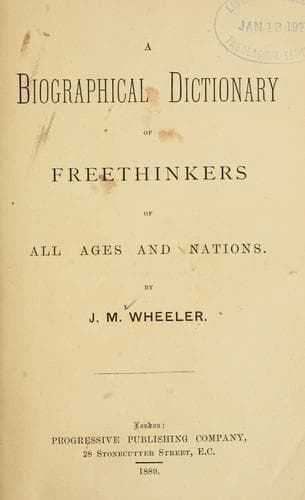
A Biographical Dictionary of Freethinkers of All Ages and NationsWheeler, J. M. (Joseph Mazzini)
Religion
A Biographical Dictionary of Freethinkers of All Ages and Nations
Wheeler, J. M. (Joseph Mazzini)
Free thought -- Biography
Campanella (Tommaso), Italian philosopher, b. Stilo, Calabria,
5 Sept. 1568. He entered the Dominican order, but was too much
attracted by the works of Telesio to please his superiors. In 1590
his Philosophia Sensibus Demonstratio was printed at Naples. Being
prosecuted, he fled to Rome, and thence to Florence, Venice,
and Padua. At Bologna some of his MS. fell into the hands of the
Inquisition, and he was arrested. He ably defended himself and was
acquitted. Returning to Calabria in 1599, he was arrested on charges
of heresy and conspiracy against the Spanish Government of Naples,
and having appealed to Rome, was sentenced to perpetual imprisonment
in the prison of the Holy Office. He was put to the torture seven
times, his torments on one occasion extending over forty hours, but
he refused to confess. He was dragged from one prison to another for
twenty-seven years, during which he wrote some sonnets, a history of
the Spanish monarchy, and several philosophical works. On 15 May,
1626, he was released by the intervention of Pope Urban VIII. He
was obliged to fly from Rome to France, where he met Gassendi. He
also visited Descartes in Holland. Julian Hibbert remarked that
his Atheismus Triumphatus--Atheism Subdued, 1631, would be better
entitled Atheismus Triumphans--Atheism Triumphant--as the author puts
his strongest arguments on the heterodox side. In his City of the Sun,
Campanella follows Plato and More in depicting an ideal republic and a
time when a new era of earthly felicity should begin. Hallam says "The
strength of Campanella's genius lay in his imagination." His "Sonnets"
have been translated by J. A. Symonds. Died Paris, 21 May, 1639.
Campbell (Alexander), Socialist of Glasgow, b. about the beginning
of the century. He early became a Socialist, and was manager at
the experiment at Orbiston under Abram Combe, of whom he wrote
a memoir. Upon the death of Combe, 1827, he became a Socialist
missionary in England. He took an active part in the co-operative
movement, and in the agitation for an unstamped press, for which he
was tried and imprisoned at Edinburgh, 1833-4. About 1849 he returned
to Glasgow and wrote on the Sentinel. In 1867 he was presented with
a testimonial and purse of 90 sovereigns by admirers of his exertions
in the cause of progress. Died about 1873.
Campion (William), a shoemaker, who became one of R. Carlile's
shopmen; tried 8 June, 1824, for selling Paine's Age of Reason. After
a spirited defence he was found guilty and sentenced to three years'
imprisonment. In prison he edited, in conjunction with J. Clarke,
E. Hassell, and T. R. Perry, the Newgate Monthly Magazine, to which
he contributed some thoughtful papers, from Sept. 1824, to Aug. 1826,
when he was removed to the Compter.
Public-domain text, read in full here on John Shaqi.
Reviews
Reviews
No reviews yet
Be the first to share your thoughts on this work.
Elsewhere in the archive
Join the Discussion
Join the discussion
Sign in to leave a comment or review.
Sign InorCreate an account