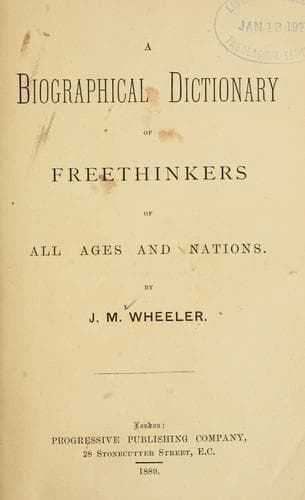
A Biographical Dictionary of Freethinkers of All Ages and NationsWheeler, J. M. (Joseph Mazzini)
Religion
A Biographical Dictionary of Freethinkers of All Ages and Nations
Wheeler, J. M. (Joseph Mazzini)
Free thought -- Biography
Cayla (Jean Mamert), French man of letters and politician b. Vigan
(Lot) 1812. Became in '37 editor of the Emancipator of Toulouse,
a city of which he wrote the history. At Paris he wrote to the
Siècle, the République Française and other journals, and published
European Celebrities and numerous anti-clerical brochures, such as
The Clerical Conspiracy, '61; The Devil, his Grandeur and Decay,
'64; Hell Demolished, '65; Suppression of Religious Orders, '70;
and The History of the Mass,'74. He died 2 May, 1877.
Cazelles (Emile), French translator of Bentham's Influence of Natural
Religion, Paris, 1875. Has also translated Mill's Subjection of Women
and his Autobiography and Essays on Religion.
Cecco d'Ascoli, i.e., Stabili (Francesco degli), Italian poet,
b. Ascoli, 1257. He taught astrology and philosophy at Bologna. In
1324 he was arrested by the Inquisition for having spoken against the
faith, and was condemned to fine and penitence. He was again accused
at Florence, and was publicly burnt as an heretic 16 Sept. 1327. His
best known work is entitled Acerba, a sort of encyclopædia in rhyme.
Cellarius (Martin), Anabaptist, who deserves mention as the first
avowed Protestant Anti-trinitarian. He studied Oriental languages
with Reuchlin and Melancthon, but having discussed with Anabaptists
acknowledged himself converted, 1522, and afterwards gave up the deity
of Christ. He was imprisoned, and on his release went to Switzerland,
where he died 11 Oct. 1564.
Celsus, a Pagan philosopher, who lived in the second century. He was
a friend of Lucian, who dedicated to him his treatise on the False
Prophet. He wrote an attack on Christianity, called The True Word. The
work was destroyed by the early Christians. The passages given by
his opponent, Origen, suffice to show that he was a man of high
attainments, well acquainted with the religion he attacked, and that
his power of logic and irony was most damaging to the Christian faith.
Cerutti (Giuseppe Antonio Gioachino), poet, converted Jesuit,
b. Turin, 13 June, 1738. He became a Jesuit, and wrote a defence of
the Society. He afterwards became a friend of Mirabeau, adopted the
principles of 1789, wrote in defence of the Revolution, and wrote
and published a Philosophical Breviary, or history of Judaism,
Christianity, and Deism, which he attributed to Frederick of
Prussia. His opinions may also be gathered from his poem, Les Jardins
de Betz, 1792. Died Paris, 3 Feb. 1792.
Chaho (J. Augustin), Basque man of letters, b. Tardets,
Basses-Pyrénées, 10 Oct. 1811. His principal works are a Philosophy of
Comparative Religion, and a Basque dictionary. At Bayonne he edited
the Ariel. In 1852 this was suppressed and he was exiled. Died 23
Oct. 1858.
Public-domain text, read in full here on John Shaqi.
Reviews
Reviews
No reviews yet
Be the first to share your thoughts on this work.
Elsewhere in the archive
Join the Discussion
Join the discussion
Sign in to leave a comment or review.
Sign InorCreate an account