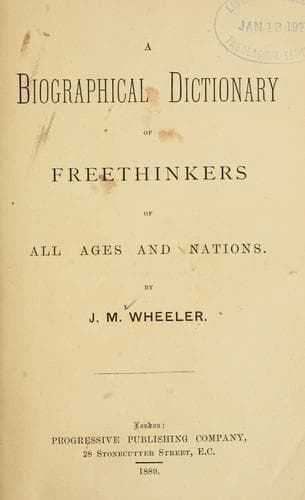
A Biographical Dictionary of Freethinkers of All Ages and NationsWheeler, J. M. (Joseph Mazzini)
Religion
A Biographical Dictionary of Freethinkers of All Ages and Nations
Wheeler, J. M. (Joseph Mazzini)
Free thought -- Biography
Chaloner (Thomas), M.P., Regicide, b. Steeple Claydon, Bucks,
1595. Educated at Oxford, he became member for Richmond (Yorks),
1645. Was a witness against Archbishop Laud, and one of King Charles's
Judges. In 1651 he was made Councillor of State. Wood says he "was as
far from being a Puritan as the east is from the west," and that he
"was of the natural religion." He wrote a pretended True and Exact
Relation of the Finding of Moses His Tomb, 1657, being a satire
directed against the Presbyterians. Upon the Restoration he fled to
the Low Countries, and died at Middelburg, Zeeland, in 1661.
Chambers (Ephraim), originator of the Cyclopædia of Arts and Sciences,
b. Kendal about 1680. The first edition of his work appeared in 1728,
and procured him admission to the Royal Society. A French translation
gave rise to Diderot and D'Alembert's Encyclopédie. Chambers also
edited the Literary Magazine, 1836, etc. His infidel opinions were
well known, and the Cyclopædia was placed upon the Index, but he was
buried in the cloisters of Westminster Abbey. Died 15 May, 1740.
Chamfort (Sébastien Roch Nicolas), French man of letters, b. in
Auvergne, near Clermont, 1741. He knew no parent but his mother,
a peasant girl, to supply whose wants he often denied himself
necessaries. At Paris he gained a prize from the Academy for his
eulogy on Molière. About 1776 he published a Dramatic Dictionary
and wrote several plays. In 1781 he obtained a seat in the Academy,
being patronised by Mme. Helvetius. He became a friend of Mirabeau,
who called him une tête électrique. In 1790 he commenced a work called
Pictures of the Revolution. In the following year he became secretary
of the Jacobin Club and National Librarian. Arrested by Robespierre,
he desperately, but vainly, endeavored to commit suicide. He died 13
April, 1794, leaving behind numerous works and a collection of Maxims,
Thoughts, Characters, and Anecdotes, which show profound genius and
knowledge of human nature.
Chapman (John), M.R.C.S., b. 1839. Has written largely in the
Westminster Review, of which he is proprietor.
Chappellsmith (Margaret), née Reynolds, b. Aldgate, 22 Feb. 1806. Early
in life she read the writings of Cobbett. In '36 she began writing
political articles in the Dispatch, and afterwards became a Socialist
and Freethought lecturess. She married John Chappellsmith in '39,
and in '42 she began business as a bookseller. In '37 she expressed
a preference for the development theory before that of creation. In
'50 they emigrated to the United States, where Mrs. Chappellsmith
contributed many articles to the Boston Investigator.
Charles (Rudolf). See Giessenburg.
Charma (Antoine), French philosopher, b. 15 Jan. 1801. In '30 he was
nominated to the Chair of Philosophy at Caen. He was denounced for
his impiety by the Count de Montalembert in the Chamber of peers,
and an endeavor was made to unseat him. He wrote many philosophical
works, and an account of Didron's Histoire de Dieu. Died 5 Aug. 1869.
Public-domain text, read in full here on John Shaqi.
Reviews
Reviews
No reviews yet
Be the first to share your thoughts on this work.
Elsewhere in the archive
Join the Discussion
Join the discussion
Sign in to leave a comment or review.
Sign InorCreate an account