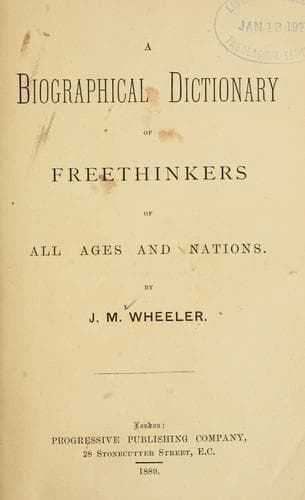
A Biographical Dictionary of Freethinkers of All Ages and NationsWheeler, J. M. (Joseph Mazzini)
Religion
A Biographical Dictionary of Freethinkers of All Ages and Nations
Wheeler, J. M. (Joseph Mazzini)
Free thought -- Biography
Chaumette (Pierre Gaspard), afterwards Anaxagoras, French
revolutionary, b. Nevers, 24 May, 1763. The son of a shoemaker, he was
in turn cabin boy, steersman, and attorney's clerk. In early youth he
received lessons in botany from Rousseau. He embraced the revolution
with ardor, was the first to assume the tri-color cockade, became
popular orator at the club of the Cordeliers, and was associated with
Proudhomme in the journal Les Revolutions de Paris. Nominated member
of the Commune 10 Aug. 1792, he took the name of Anaxagoras to show
his little regard for his baptismal saints. He was elected Procureur
Syndic, in which capacity he displayed great activity. He abolished
the rod in schools, suppressed lotteries, instituted workshops for
fallen women, established the first lying-in-hospital, had books
sent to the hospitals, separated the insane from the sick, founded
the Conservatory of Music, opened the public libraries every day
(under the ancien régime they were only open two hours per week),
replaced books of superstition by works of morality and reason, put
a graduated tax on the rich to provide for the burial of the poor,
and was the principal mover in the feasts of Reason and closing of
the churches. He was accused by Robespierre of conspiring with Cloots
"to efface all idea of the Deity," and was guillotined 13 April, 1794.
Chaussard (Pierre Jean Baptiste), French man of letters, b. Paris,
8 Oct. 1766. At the Revolution he took the name of Publicola, and
published patriotic odes, Esprit de Mirabeau, and other works. He was
preacher to the Theophilanthropists, and became professor of belles
lettres at Orleans. Died 9 Jan. 1823.
Chemin-Dupontes (Jean Baptiste), b. 1761. One of the founders of
French Theophilanthropy; published many writings, the best known of
which is entitled What is Theophilanthropy?
Chenier (Marie André de), French poet, b. Constantinople, 29
Oct. 1762. His mother, a Greek, inspired him with a love for ancient
Greek literature. Sent to college at Paris, he soon manifested his
genius by writing eclogues and elegies of antique simplicity and
sensibility. In 1787 he came to England as Secretary of Legation. He
took part in the legal defence of Louis XVI., eulogised Charlotte
Corday, and gave further offence by some letters in the Journal de
Paris. He was committed to prison, and here met his ideal in the
Comtesse de Coigny. Confined in the same prison, to her he addressed
the touching verses, The Young Captive (La jeune Captive). He was
executed 25 July, 1794, leaving behind, among other poems, an imitation
of Lucretius, entitled Hermes, which warrants the affirmation of de
Chênedolle, that "André Chénier était athée avec délices."
Public-domain text, read in full here on John Shaqi.
Reviews
Reviews
No reviews yet
Be the first to share your thoughts on this work.
Elsewhere in the archive
Join the Discussion
Join the discussion
Sign in to leave a comment or review.
Sign InorCreate an account