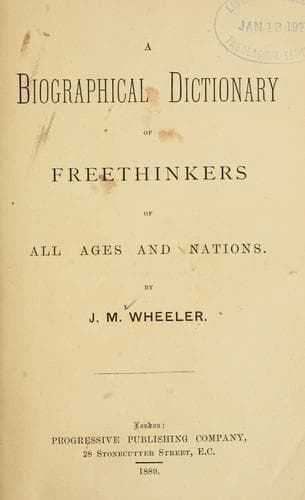
A Biographical Dictionary of Freethinkers of All Ages and NationsWheeler, J. M. (Joseph Mazzini)
Religion
A Biographical Dictionary of Freethinkers of All Ages and Nations
Wheeler, J. M. (Joseph Mazzini)
Free thought -- Biography
Condorcet (Sophie de Grouchy Caritat, Marquise de), wife of above,
and sister of General Grouchy and of Mme. Cabanis, b. 1765. She
married Condorcet 1786, and was considered one of the most beautiful
women of her time. She shared her husband's sentiments and opinions
and, while he was proscribed, supported herself by portrait
painting. She was arrested, and only came out of prison after the
fall of Robespierre. She translated Adam Smith's Theory of the Moral
Sentiments, which she accompanied with eight letters on Sympathy,
addressed to Cabanis. She died 8 Sept. 1822. Her only daughter married
Gen. Arthur O'Connor.
Confucius (Kung Kew) or Kung-foo-tsze, the philosopher Kung, a
Chinese sage, b. in the State of Loo, now part of Shantung, about
B.C. 551. He was distinguished by filial piety and learning. In his
nineteenth year he married, and three years after began as a teacher,
rejecting none who came to him. He travelled through many states. When
past middle age he was appointed chief minister of Loo, but finding
the Duke desired the renown of his name without adopting his counsel,
he retired, and devoted his old age to editing the sacred classics
of China. He died about B.C. 478. His teaching, chiefly found in the
Lun-Yu, or Confucian Analects, was of a practical moral character,
and did not include any religious dogmas.
Congreve (Richard), English Positivist, born in 1819. Educated at
Rugby under T. Arnold, and Oxford 1840, M.A. 1843; was fellow of
Wadham College 1844-54. In '55 he published his edition of Aristotle
Politics. He became a follower of Comte and influenced many to embrace
Positivism. Translated Comte's Catechism of Positive Philosophy, 1858,
and has written many brochures. Dr. Congreve is considered the head
of the strict or English Comtists, and has long conducted a small
"Church of Humanity."
Connor (Bernard), a physician, b. Co. Kerry, of Catholic family,
1666. He travelled widely, and was made court physician to John
Sobieski, King of Poland. He wrote a work entitled Evangelium Medici
(1697), in which he attempts to account for the Christian miracles
on natural principles. For this he was accused of Atheism. He died
in London 27 Oct. 1698.
Constant de Rebecque (Henri Benjamin), Swiss writer, b. Lausanne,
25 Oct. 1767, and educated at Oxford, Erlangen and Edinburgh. In
1795 he entered Paris as a protégé of Mme. de Stael, and in 1799
became a member of the Tribunal. He opposed Buonaparte and wrote
on Roman Polytheism and an important work on Religion Considered in
its Source, its Forms and its Developments (6 vols.; 1824-32). Died
8 Dec. 1830. Constant professed Protestantism, but was at heart a
sceptic, and has been called a second Voltaire. A son was executor
to Auguste Comte.
Public-domain text, read in full here on John Shaqi.
Reviews
Reviews
No reviews yet
Be the first to share your thoughts on this work.
Elsewhere in the archive
Join the Discussion
Join the discussion
Sign in to leave a comment or review.
Sign InorCreate an account