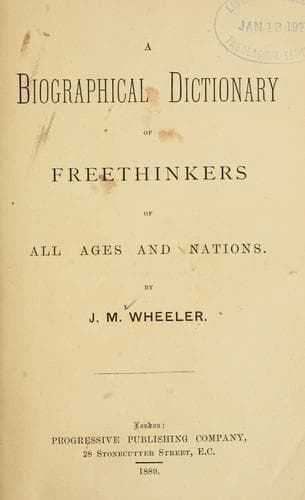
A Biographical Dictionary of Freethinkers of All Ages and NationsWheeler, J. M. (Joseph Mazzini)
Religion
A Biographical Dictionary of Freethinkers of All Ages and Nations
Wheeler, J. M. (Joseph Mazzini)
Free thought -- Biography
Among other works, Comte
published A General View of Positivism, '48, translated by Dr. Bridges,
'65; A System of Positive Polity, '51, translated by Drs. Bridges,
Beesley, F. Harrison, etc., '75-79; and A Positive Catechism, '54,
translated by Dr. Congreve, '58. He also wrote on Positive Logic,
which he intended to follow with Positive Morality and Positive
Industrialism. Comte was a profound and suggestive thinker. He
resolutely sets aside all theology and metaphysics, coordinates
the sciences and substitutes the service of man for the worship of
God. Mr. J. Cotter Morison says "He belonged to that small class
of rare minds, whose errors are often more valuable and stimulating
than other men's truths." He died of cancer in the stomach at Paris,
5 Sept. 1857.
Condillac (Etienne Bonnot de), French philosopher, b. Grenoble,
about 1715. His life was very retired, but his works show much
acuteness. They are in 23 vols., the principal being A Treatise on the
Sensations, 1764; A Treatise on Animals, and An Essay on the Origin
of Human Knowledge. In the first-named he shows that all mental life
is gradually built up out of simple sensations. Died 3 Aug. 1780.
Condorcet (Marie Jean Antoine Nicolas Caritat, Marquis de),
French philosopher and politician, b. Ribemont, Picardy, 17
Sept. 1743. Dedicated to the Virgin by a pious mother, he was kept
in girl's clothes until the age of 11. Sent to a Jesuit's school,
he soon gave up religion. At sixteen he maintained a mathematical
thesis in the presence of Alembert. In the next year he dedicated
to Turgot a Profession of Faith. After some mathematical works, he
was made member of the Academy, of which he was appointed perpetual
secretary, 1773. In 1776 he published his atheistic Letters of a
Theologian. He also wrote biographies of Turgot and Voltaire, and
in favor of American independence and against negro slavery. In
1791 he represented Paris in the National Assembly, of which he
became Secretary. It was on his motion that, in the following year,
all orders of nobility were abolished. Voting against the death of
the king and siding with the Gironde drew on him the vengeance of
the extreme party. He took shelter with Madame Vernet, but fearing to
bring into trouble her and his wife, at whose instigation he wrote his
fine Sketch of the Progress of the Human Mind while in hiding, he left,
but, being arrested, died of exhaustion or by poison self-administered,
at Bourg la Reine, 27 March, 1794.
Public-domain text, read in full here on John Shaqi.
Reviews
Reviews
No reviews yet
Be the first to share your thoughts on this work.
Elsewhere in the archive
Join the Discussion
Join the discussion
Sign in to leave a comment or review.
Sign InorCreate an account