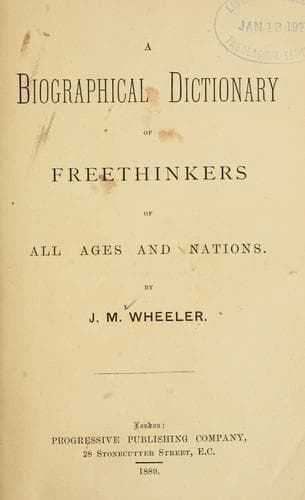
A Biographical Dictionary of Freethinkers of All Ages and NationsWheeler, J. M. (Joseph Mazzini)
Religion
A Biographical Dictionary of Freethinkers of All Ages and Nations
Wheeler, J. M. (Joseph Mazzini)
Free thought -- Biography
Cooper (Thomas), M.D., LL.D., natural philosopher, politician,
jurist and author, b. London, 22 Oct. 1759. Educated at Oxford, he
afterwards studied law and medicine; was admitted to the bar and lived
at Manchester, where he wrote a number of tracts on "Materialism,"
"Whether Deity be a Free Agent," etc., 1789. Deputed with James
Watt, the inventor, by the Constitutional clubs to congratulate
the Democrats of France (April, 1792), he was attacked by Burke
and replied in a vigorous pamphlet. In '94 he published Information
Concerning America, and in the next year followed his friend Priestly
to Philadelphia, established himself as a lawyer and was made judge. He
also conducted the Emporium of Arts and Sciences in that city. He was
Professor of Medicine at Carlisle College, '12, and afterwards held
the chairs both of Chemistry and Political Economy in South Carolina
College, of which he became President, 1820-34. This position he was
forced to resign on account of his religious views. He translated
from Justinian and Broussais, and digested the Statutes of South
Carolina. In philosophy a Materialist, in religion a Freethinker,
in politics a Democrat, he urged his views in many pamphlets. One on
The Right of Free Discussion, and a little book on Geology and the
Pentateuch, in reply to Prof. Silliman, were republished in London
by James Watson. Died at Columbia, 11 May, 1840. [1]
[1] So varied was the activity of T. Cooper during his long life that
his works in the British Museum were catalogued as by six different
persons of the same name. I pointed this out, and the six single
gentlemen will be rolled into one.
Coornhert (Dirk Volkertszoon), Dutch humanist, poet and writer,
b. Amsterdam, 1522. He travelled in his youth through Spain
and Portugal. He set up as an engraver at Haarlem, and became
thereafter notary and secretary of the city of Haarlem. He had a
profound horror of intolerance, and defended liberty against Beza and
Calvin. The clergy vituperated him as a Judas and as instigated by
Satan, etc. Bayle, who writes of him as Theodore Koornhert, says he
communed neither with Protestants nor Catholics. The magistrates of
Delft drove him out of their city. He translated Cicero's De Officiis,
and other works. Died at Gouda, 20 Oct. 1590.
Cordonnier de Saint Hyacinthe. See Saint-Hyacinthe (Themiseuil de).
Public-domain text, read in full here on John Shaqi.
Reviews
Reviews
No reviews yet
Be the first to share your thoughts on this work.
Elsewhere in the archive
Join the Discussion
Join the discussion
Sign in to leave a comment or review.
Sign InorCreate an account