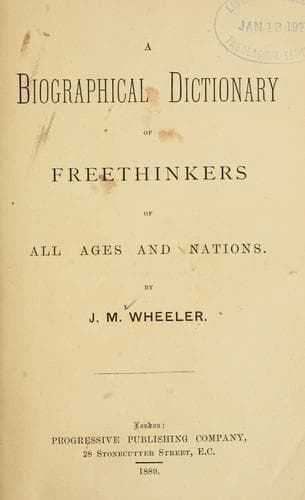
A Biographical Dictionary of Freethinkers of All Ages and NationsWheeler, J. M. (Joseph Mazzini)
Religion
A Biographical Dictionary of Freethinkers of All Ages and Nations
Wheeler, J. M. (Joseph Mazzini)
Free thought -- Biography
Corvin-Wiersbitski (Otto Julius Bernhard von), Prussian Pole of noble
family, who traced their descent from the Roman Corvinii, b. Gumbinnen,
12 Oct. 1812. He served in the Prussian army, where he met his friend
Friedrich von Sallet; retired into the Landwehr 1835, went to Leipsic
and entered upon a literary career, wrote the History of the Dutch
Revolution, 1841; the History of Christian Fanaticism, 1845, which
was suppressed in Austria. He took part with the democrats in '48;
was condemned to be shot 15 Sept. '49, but the sentence was commuted;
spent six years' solitary confinement in prison; came to London,
became correspondent to the Times; went through American Civil War,
and afterwards Franco-Prussian War, as a special correspondent. He
has written a History of the New Time, 1848-71. Died since 1886.
Cotta (Bernhard), German geologist, b. Little Zillbach, Thuringia,
24 Oct. 1808. He studied at the Academy of Mining, in Freiberg,
where he was appointed professor in '42. His first production, The
Dendroliths, '32, proved him a diligent investigator. It was followed
by many geological treatises. Cotta did much to support the nebular
hypothesis and the law of natural development without miraculous
agency. He also wrote on phrenology. Died at Freiburg, 13 Sept 1879.
Cotta (C. Aurelius), Roman philosopher, orator and statesman,
b. B.C. 124. In '75 he became Consul. On the expiration of his
office he obtained Gaul as a province. Cicero had a high opinion of
him and gives his sceptical arguments in the third book of his De
Natura Deorum.
Courier (Paul Louis), French writer, b. Paris, 4 Jan. 1772. He entered
the army and became an officer of artillery, serving with distinction
in the Army of the Republic. He wrote many pamphlets, directed against
the clerical restoration, which place him foremost among the literary
men of the generation. His writings are now classics, but they brought
him nothing but imprisonment, and he was apparently assassinated,
10 April, 1825. He had a presentiment that the bigots would kill him.
Coventry (Henry), a native of Cambridgeshire, b. about 1710, Fellow
of Magdalene College, author of Letters of Philemon to Hydaspus on
False Religion (1736). Died 29 Dec. 1752.
Coward (William), M.D., b. Winchester, 1656. Graduated at Wadham
College, Oxford, 1677. Settled first at Northampton, afterwards
at London. Published, besides some medical works, Second Thoughts
Concerning Human Soul, which excited much indignation by denying
natural immortality. The House of Commons (17 March, 1704) ordered
his work to be burnt. He died in 1725.
Public-domain text, read in full here on John Shaqi.
Reviews
Reviews
No reviews yet
Be the first to share your thoughts on this work.
Elsewhere in the archive
Join the Discussion
Join the discussion
Sign in to leave a comment or review.
Sign InorCreate an account