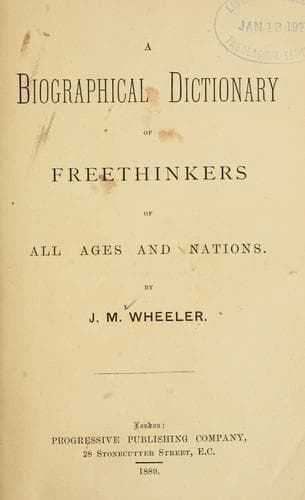
A Biographical Dictionary of Freethinkers of All Ages and NationsWheeler, J. M. (Joseph Mazzini)
Religion
A Biographical Dictionary of Freethinkers of All Ages and Nations
Wheeler, J. M. (Joseph Mazzini)
Free thought -- Biography
Cuffeler (Abraham Johann), a Dutch philosopher and doctor of law,
who was one of the first partizans of Spinoza. He lived at Utrecht
towards the end of the seventeenth century, and wrote a work on
logic in three parts entitled Specimen Artis Ratiocinandi, etc.,
published ostensibly at Hamburg, but really at Amsterdam or Utrecht,
1684. It was without name but with the author's portrait.
Cuper (Frans), Dutch writer, b. Rotterdam. Cuper is suspected to have
been one of those followers of Spinoza, who under pretence of refuting
him, set forth and sustained his arguments by feeble opposition. His
work entitled Arcana Atheismi Revelata, Rotterdam 1676, was denounced
as written in bad faith. Cuper maintained that the existence of God
could not be proved by the light of reason.
Cyrano de Bergerac (Savinien), French comic writer, b. Paris 6 March,
1619. After finishing his studies and serving in the army in his youth
he devoted himself to literature. His tragedy "Agrippine" is full of
what a bookseller called "belles impiétés," and La Monnoye relates that
at its performance the pit shouted "Oh, the wretch! The Atheist! How
he mocks at holy things!" Cyrano knew personally Campanella, Gassendi,
Lamothe Le Vayer, Linière, Rohault, etc. His other works consist of
a short fragment on Physic, a collection of Letters, and a Comic
History of the States and Empires of the Moon and the Sun. Cyrano
took the idea of this book from F. Godwin's Man in the Moon, 1583,
and it in turn gave rise to Swift's Gulliver's Travels and Voltaire's
Micromegas. Died Paris, 1655.
Czolbe (Heinrich), German Materialist, b. near Dantzic, 30 Dec. 1819,
studied medicine at Berlin, writing an inaugural dissertation on
the Principles of Physiology, '44. In '55 he published his New
Exposition of Sensationalism, in which everything is resolved into
matter and motion, and in '65 a work on The Limits and Origin of Human
Knowledge. He was an intimate friend of Ueberweg. Died at Königsberg,
19 Feb. 1873. Lange says "his life was marked by a deep and genuine
morality."
D'Ablaing. See Giessenburg.
Dale (Antonius van), Dutch writer, b. Haarlem, 8 Nov. 1638. His work
on oracles was erudite but lumbersome, and to it Fontenelle gave the
charm of style. It was translated into English by Mrs. Aphra Behn,
under the title of The History of Oracles and the Cheats of Pagan
Priests, 1699. Van Dale, in another work on The Origin and Progress
of Idolatry and Superstition, applied the historical method to his
subject, and showed that the belief in demons was as old and as
extensive as the human race. He died at Haarlem, 28 Nov. 1708.
Public-domain text, read in full here on John Shaqi.
Reviews
Reviews
No reviews yet
Be the first to share your thoughts on this work.
Elsewhere in the archive
Join the Discussion
Join the discussion
Sign in to leave a comment or review.
Sign InorCreate an account