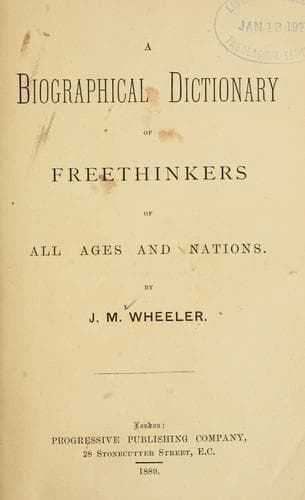
A Biographical Dictionary of Freethinkers of All Ages and NationsWheeler, J. M. (Joseph Mazzini)
Religion
A Biographical Dictionary of Freethinkers of All Ages and Nations
Wheeler, J. M. (Joseph Mazzini)
Free thought -- Biography
Darwin (Charles Robert), English naturalist, b. Shrewsbury,
12 Feb. 1809. Educated at Shrewsbury, Edinburgh University, and
Cambridge. He early evinced a taste for collecting and observing
natural objects. He was intended for a clergyman, but, incited by
Humboldt's Personal Narrative, resolved to travel. He accompanied
Captain Fitzroy in the "Beagle" on a voyage of exploration, '31-36,
which he narrated in his Voyage of a Naturalist Round the World, which
obtained great popularity. In '39 he married, and in '42 left London
and settled at Down, Kent. His studies, combined with the reading of
Lamarck and Malthus, led to his great work on The Origin of Species
by means of Natural Selection, '59, which made a great outcry and
marked an epoch. Darwin took no part in the controversy raised by the
theologians, but followed his work with The Fertilisation of Orchids,
'62; Cross and Self Fertilisation of Plants, '67; Variations of
Plants and Animals under Domestication, '65; and in '71 The Descent
of Man and Selection in relation to Sex, which caused yet greater
consternation in orthodox circles. The following year he issued The
Expression of the Emotions of Men and Animals. He also published
works on the Movements of Plants, Insectivorous Plants, the Forms of
Flowers, and Earthworms. He died 19 April, 1882, and was buried in
Westminster Abbey, despite his expressed unbelief in revelation. To
a German student he wrote, in '79, "Science has nothing to do with
Christ, except in so far as the habit of scientific research makes
a man cautious in admitting evidence. For myself I do not believe
that there ever has been any revelation." In his Life and Letters
he relates that between 1836 and 1842 he had come to see "that the
Old Testament was no more to be trusted than the sacred books of the
Hindoos." He rejected design and said "I for one must be content to
remain an Agnostic."
Darwin (Erasmus), Dr., poet, physiologist and philosopher, grandfather
of the above, was born at Elston, near Newark, 12 Dec. 1731. Educated
at Chesterfield and Cambridge he became a physician, first at Lichfield
and afterwards at Derby. He was acquainted with Rousseau, Watt and
Wedgwood. His principal poem, The Botanic Garden was published in 1791,
and The Temple of Nature in 1803. His principal work is Zoomania,
or the laws of organic life (1794), for which he was accused of
Atheism. He was actually a Deist. He also wrote on female education
and some papers in the Philosophical Transactions. Died at Derby,
18 April, 1802.
Daubermesnil (François Antoine), French conventionalist. Elected
deputy of Tarn in 1792. Afterwards became a member of the Council of
Five Hundred. He was one of the founders of Theophilanthropy. Died
at Perpignan 1802.
Daudet (Alphonse), French novelist, b. at Nîmes, 13 May 1840, author
of many popular romances, of which we mention L'Evangeliste, '82,
which has been translated into English under the title Port Salvation.
Public-domain text, read in full here on John Shaqi.
Reviews
Reviews
No reviews yet
Be the first to share your thoughts on this work.
Elsewhere in the archive
Join the Discussion
Join the discussion
Sign in to leave a comment or review.
Sign InorCreate an account