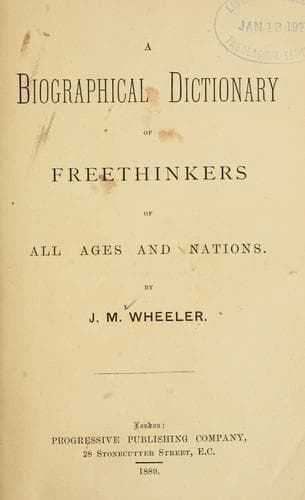
A Biographical Dictionary of Freethinkers of All Ages and NationsWheeler, J. M. (Joseph Mazzini)
Religion
A Biographical Dictionary of Freethinkers of All Ages and Nations
Wheeler, J. M. (Joseph Mazzini)
Free thought -- Biography
Daunou (Pierre Claude François), French politician and historian,
b. Boulogne, 18 Aug. 1761. His father entered him in the congregation
of the Fathers of the Oratory, which he left at the Revolution. The
department of Calais elected him with Carnot and Thomas Paine to
the Convention. After the Revolution he became librarian at the
Pantheon. He was a friend of Garat, Cabanis, Chenier, Destutt Tracy,
Ginguené and Benj. Constant. Wrote Historical Essay on the Temporal
Power of the Popes, 1810. Died at Paris, 20 June, 1840, noted for
his benevolence.
Davenport (Allen), social reformer, b. 1773. He contributed to
Carlile's Republican; wrote an account of the Life, Writings and
Principles of Thomas Spence, the reformer (1826); and published a
volume of verse, entitled The Muses' Wreath (1827). Died at Highbury,
London, 1846.
Davenport (John), Deist, b. London, 8 June, 1789, became a teacher. He
wrote An Apology for Mohammed and the Koran, 1869; Curiositates
Eroticoe Physiologæ, or Tabooed Subjects Freely Treated, and several
educational works. Died in poverty 11 May, 1877.
David of Dinant, in Belgium, Pantheistic philosopher of the twelfth
century. He is said to have visited the Papal Court of Innocent
III. He shared in the heresies of Amalric of Chârtres, and his work
Quaterini was condemned and burnt (1209). He only escaped the stake
by rapid flight. According to Albert the Great he was the author of
a philosophical work De Tomis, "Of Subdivisions," in which he taught
that all things were one. His system was similar to that of Spinoza.
David (Jacques Louis), French painter, born at Paris, 31 Aug. 1748,
was made painter to the king, but joined the Jacobin Club, became
a member of the Convention, voted for the king's death and for the
civic festivals, for which he made designs. On the restoration he
was banished. Died at Brussels, 29 Dec. 1825. David was an honest
enthusiast and a thorough Freethinker.
Davidis or David (Ferencz), a Transylvanian divine, b. about
1510. He was successively a Roman Catholic, a Lutheran and an
Antitrinitarian. He went further than F. Socinus and declared there
was "as much foundation for praying to the Virgin Mary and other
dead saints as to Jesus Christ." He was in consequence accused of
Judaising and thrown into prison at Deva, where he died 6 June, 1579.
Davies (John C.), of Stockport, an English Jacobin, who in 1797
published a list of contradictions of the Bible under the title of The
Scripturian's Creed, for which he was prosecuted and imprisoned. The
work was republished by Carlile, 1822, and also at Manchester, 1839.
Davidson (Thomas), bookseller and publisher, was prosecuted by the Vice
Society in Oct. 1820, for selling the Republican and a publication
of his own, called the Deist's Magazine. For observations made in
his defence he was summoned and fined £100, and he was sentenced to
two years' imprisonment in Oakham Gaol. He died 16 Dec. 1826.
Public-domain text, read in full here on John Shaqi.
Reviews
Reviews
No reviews yet
Be the first to share your thoughts on this work.
Elsewhere in the archive
Join the Discussion
Join the discussion
Sign in to leave a comment or review.
Sign InorCreate an account