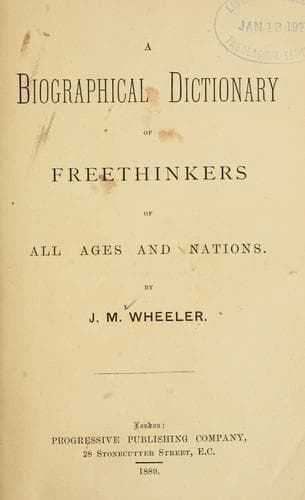
A Biographical Dictionary of Freethinkers of All Ages and NationsWheeler, J. M. (Joseph Mazzini)
Religion
A Biographical Dictionary of Freethinkers of All Ages and Nations
Wheeler, J. M. (Joseph Mazzini)
Free thought -- Biography
Debierre (Charles), French writer, author of Man Before History, 1888.
De Dominicis. See Dominicis.
De Felice (Francesco), Italian writer, b. Catania, Sicily, 1821,
took part in the revolution of '43, and when Garibaldi landed in
Sicily was appointed president of the provisional council of war. Has
written on the reformation of elementary schools.
De Greef (Guillaume Joseph), advocate at Brussels Court of Appeal,
b. at Brussels, 9 Oct. 1842. Author of an important Introduction to
Sociology, 1886. Wrote in La Liberté, 1867-73, and now writes in La
Societé Nouvelle.
De Gubernatis (Angelo), Italian Orientalist and writer, b. Turin,
7 April, 1840; studied at Turin University and became doctor of
philosophy. He studied Sanskrit under Bopp and Weber at Berlin. Sig. de
Gubernatis has adorned Italian literature with many important
works, of which we mention his volumes on Zoological Mythology,
which has been translated into English, '72: and on the Mythology of
Plants. He has compiled and in large part written a Universal History
of Literature, 18 vols. '82-85; edited La Revista Europea and the
Revue Internationale, and contributed to many publications. He is a
brilliant writer and a versatile scholar.
De Harven (Emile Jean Alexandre), b. Antwerp, 23 Sept. 1837, the
anonymous author of a work on The Soul: its Origin and Destiny
(Antwerp, 1879).
Dekker (Eduard Douwes), the greatest Dutch writer and Freethinker of
this century, b. Amsterdam, 2 March, 1820. In '39 he accompanied his
father, a ship's captain, to the Malayan Archipelago. He became officer
under the Dutch government in Sumatra, Amboina, and Assistant-Resident
at Lebac, Java. He desired to free the Javanese from the oppression of
their princes, but the government would not help him and he resigned
and returned to Holland, '56. The next four years he spent, in poverty,
vainly seeking justice for the Javanese. In '60 he published under the
pen name of "Multatuli" Max Havelaar, a masterly indictment of the
Dutch rule in India, which has been translated into German, French
and English. Then follow his choice Minnebrieven (Love Letters),
'61; Vorstenschool (A School for Princes), and Millioenen Studiën
(Studies on Millions). His Ideën, 7 vols. '62-79, are full of the
boldest heresy. In most of his works religion is attacked, but in the
Ideas faith is criticised with much more pungency and satire. He wrote
"Faith is the voluntary prison-cell of reason." He was an honorary
member of the Freethought Society, De Dageraad, and contributed to its
organ. During the latter years of his life he lived at Wiesbaden, where
he died 19 Feb. 1887. His corpse was burned in the crematory at Gotha.
De Lalande (see Lalande).
Public-domain text, read in full here on John Shaqi.
Reviews
Reviews
No reviews yet
Be the first to share your thoughts on this work.
Elsewhere in the archive
Join the Discussion
Join the discussion
Sign in to leave a comment or review.
Sign InorCreate an account