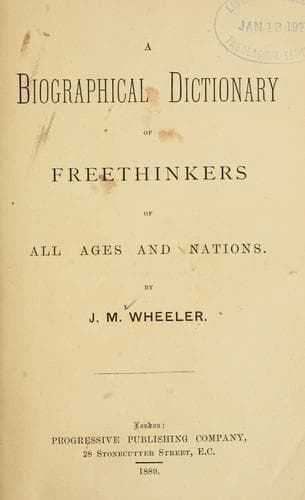
A Biographical Dictionary of Freethinkers of All Ages and NationsWheeler, J. M. (Joseph Mazzini)
Religion
A Biographical Dictionary of Freethinkers of All Ages and Nations
Wheeler, J. M. (Joseph Mazzini)
Free thought -- Biography
Dreyfus (Ferdinand Camille), author of an able work on the Evolution
of Worlds and Societies, 1888.
Droysen (Johann Gustav), German historian, b. Treptoir, 6 July,
1808. Studied at Berlin; wrote in the Hallische Jahrbücher; was
Professor of History at Keil, 1840; Jena '51 and Berlin '59. Has edited
Frederick the Great's Correspondence, and written other important
works, some in conjunction with his friend Max Duncker. Died 15
June, 1882.
Drummond (Sir William), of Logie Almond, antiquary and author,
b. about 1770; entered Parliament as member for St. Mawes, Cornwall,
1795. In the following year he became envoy to the court of Naples,
and in 1801 ambassador to Constantinople. His principal work is
Origines, or Remarks on the Origin of several Empires, States,
and Cities (4 vols. 1824-29). He also printed privately The OEdipus
Judaicus, 1811. It calls in question, with much boldness and learning,
many legends of the Old Testament, to which it gave an astronomical
signification. It was reprinted in '66. Sir William Drummond also
wrote anonymously Philosophical Sketches of the Principles of Society,
1795. Died at Rome, 29 March, 1828.
Duboc (Julius) German writer and doctor of philosophy b. Hamburg, 10
Oct. 1829. Educated at Frankfurt and Giessen, is a clever journalist,
and has translated the History of the English Press. Has written
an Atheistic work, Das Leben Ohne Gott (Life without God), with the
motto from Feuerbach "No religion is my religion, no philosophy my
philosophy," 1875. He has also written on the Psychology of Love,
and other important works.
Dubois (Pierre), a French sceptic, who in 1835 published The True
Catechism of Believers--a work ordered by the Court of Assizes to
be suppressed, and for which the author (Sept. '35) was condemned to
six months' imprisonment and a fine of one thousand francs. He also
wrote The Believer Undeceived, or Evident Proofs of the Falsity and
Absurdity of Christianity; a work put on the Index in '36.
Du Bois-Reymond (Emil), biologist, of Swiss father and French
mother, b. Berlin, 7 Nov. 1818. He studied at Berlin and Bonn for
the Church, but left it to follow science, '37. Has become famous as
a physiologist, especially by his Researches in Animal Electricity,
'48-60. With Helmholtz he has done much to establish the new era
of positive science, wrongly called by opponents Materialism. Du
Bois-Reymond holds that thought is a function of the brain and nervous
system, and that "soul" has arisen as the gradual results of natural
combinations, but in his Limits of the Knowledge of Nature, '72, he
contends that we must always come to an ultimate incomprehensible. Du
Bois-Reymond has written on Voltaire and Natural Science, '68; La
Mettrie, '75; Darwin versus Galiani, '78; and Frederick II. and
Rousseau, '79. Since '67 he has been perpetual secretary of the
Academy of Sciences, Berlin.
Public-domain text, read in full here on John Shaqi.
Reviews
Reviews
No reviews yet
Be the first to share your thoughts on this work.
Elsewhere in the archive
Join the Discussion
Join the discussion
Sign in to leave a comment or review.
Sign InorCreate an account