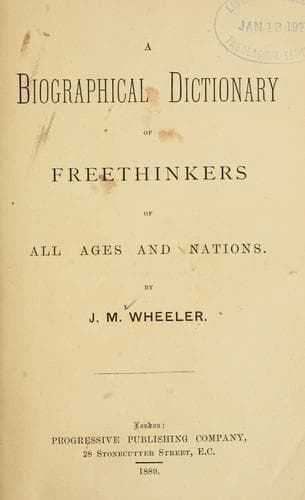
A Biographical Dictionary of Freethinkers of All Ages and NationsWheeler, J. M. (Joseph Mazzini)
Religion
A Biographical Dictionary of Freethinkers of All Ages and Nations
Wheeler, J. M. (Joseph Mazzini)
Free thought -- Biography
Edelmann (Johann Christian), German Deist, b. Weissenfels, Saxony,
9 July, 1698; studied theology in Jena, joined the Moravians,
but left them and every form of Christianity, becoming an adherent
of Spinozism. His principal works are his Unschuldige Wahrheiten,
1735 (Innocent Truths), in which he argues that no religion is of
importance, and Moses mit Aufgedecktem Angesicht (Moses Unmasked),
1740, an attack on the Old Testament, which, he believed, proceeded
from Ezra; Die Göttlichkeit der Vernunft (The Divinity of Reason),
1741, and Christ and Belial. His works excited much controversy, and
were publicly burnt at Frankfort, 9 May, 1750. Edelmann was chased
from Brunswick and Hamburg, but was protected by Frederick the Great,
and died at Berlin, 15 Feb. 1767. Mirabeau praised him, and Guizot
calls him a "fameux esprit fort."
Edison (Thomas Alva), American inventor, b. Milan, Ohio, 10
Feb. 1847. As a boy he sold fruit and papers at the trains. He read,
however, Gibbon, Hume and other important works before he was ten. He
afterwards set up a paper of his own, then became telegraph operator,
studied electricity, invented electric light, the electric pen,
the telephone, microphone, phonograph, etc. Edison is known to be an
Agnostic and to pay no attention to religion.
Eenens (Ferdinand), Belgian writer, b. Brussels, 7 Dec. 1811. Eenens
was an officer in the Belgian army, and wrote many political and
anti-clerical pamphlets. He also wrote La Vérité, a work on the
Christian faith, 1859; Le Paradis Terrestre, '60, an examination of
the legend of Eden, and Du Dieu Thaumaturge, '76. He used the pen
names "Le Père Nicaise," "Nicodème Polycarpe" and "Timon III." Died
at Brussels in 1883.
Effen (Justus van), Dutch writer, b. Utrecht, 11 Feb. 1684. Edited the
Misanthrope, Amsterdam, 1712-16; translated Robinson Crusoe, Swift's
Tale of a Tub, and Mandeville's Thoughts on Religion, 1722; published
the Dutch Spectator, 1731-35. Died at Bois-le-Duc, 18 Sept. 1735.
Eichhorn (Johann Gottfried), German Orientalist and rationalist, b. 16
Oct. 1752, became Professor of Oriental Literature and afterwards
Professor of Theology at Gottingen. He published Introductions to
the Old and New Testaments and A Commentary on the Apocalypse, in
which his criticism tends to uproot belief in the Bible as a divine
revelation. He lectured every day for fifty-two years. Died 25 June,
1827.
"Elborch (Conrad von)," the pseudonym of a living learned Dutch writer,
whose position does not permit him to reveal his true name. Born
14 Jan. 1865, he has contributed to De Dageraad (The Daybreak),
under various pen-names, as "Fra Diavolo," "Denis Bontemps," "J. Van
den Ende," etc. He has given, in '88, a translation of the rare and
famous Latin treatise, De Tribus Impostoribus (On Three Impostors)
[Jesus, Moses, and Muhammad], with an important bibliographic and
historical introduction.
Public-domain text, read in full here on John Shaqi.
Reviews
Reviews
No reviews yet
Be the first to share your thoughts on this work.
Elsewhere in the archive
Join the Discussion
Join the discussion
Sign in to leave a comment or review.
Sign InorCreate an account