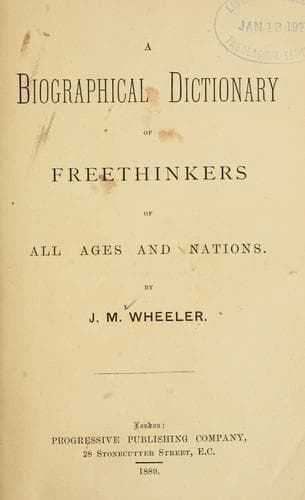
A Biographical Dictionary of Freethinkers of All Ages and NationsWheeler, J. M. (Joseph Mazzini)
Religion
A Biographical Dictionary of Freethinkers of All Ages and Nations
Wheeler, J. M. (Joseph Mazzini)
Free thought -- Biography
"Eliot (George)," the pen-name of Mary Ann Lewes (née Evans) one of
the greatest novelists of the century, b. at Arbury Farm, near Griff,
Warwickshire, 22 Nov. 1819. In '41 the family removed to Foleshill,
near Coventry. Here she made the friendship of the household of
Charles Bray, and changed her views from Evangelical Christianity
to philosophical scepticism. Influenced by The Inquiry into the
Origin of Christianity, by C. C. Hennell (Bray's brother-in-law),
she made an analysis of that work. Her first literary venture was
translating Strauss' Leben Jesu, published in 1846. After the death
of her father ('49) she travelled with the Brays upon the Continent,
and upon her return assisted Dr. Chapman in the editorship of the
Westminster Review, to which she contributed several articles. She
translated Feuerbach's Essence of Christianity, '54, the only work
published with her real name, and also translated from Spinoza's
Ethics. Introduced by Herbert Spencer to George Henry Lewes, she
linked her life with his in defiance of the conventions of society,
July, '54. Both were poor, but by his advice she turned to fiction,
in which she soon achieved success. Her Scenes of Clerical Life, Adam
Bede, Mill on the Floss, Silas Marner, Romola, Felix Holt, Middlemarch,
Daniel Deronda, and Theophrastus Such have become classics. As a poet,
"George Eliot" does not rank so high, but her little piece, "Oh,
may I join the choir invisible," well expresses the emotion of the
Religion of Humanity, and her Spanish Gipsy she allowed was "a mass
of Positivism." Lewes died in 1878, and within two years she married
his friend, J. W. Cross. Her new happiness was short-lived. She died
22 Dec. 1880, and is buried with Lewes at Highgate.
Ellero (Pietro) Italian jurisconsult, b. Pordenone, 8 Oct. 1833,
Counsellor of the High Court of Rome, has been Professor of Criminal
Law in the University of Bologna. Author of many works on legal and
social questions. His Scritti Minori, Scritti Politici and La Question
Sociale have the honor of a place on the Roman Index.
Public-domain text, read in full here on John Shaqi.
Reviews
Reviews
No reviews yet
Be the first to share your thoughts on this work.
Elsewhere in the archive
Join the Discussion
Join the discussion
Sign in to leave a comment or review.
Sign InorCreate an account