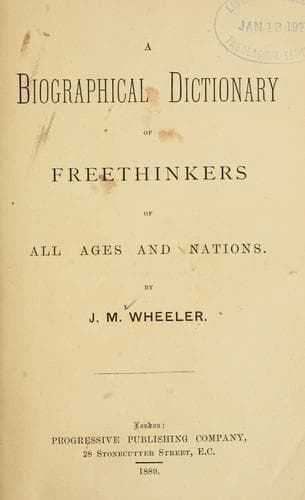
A Biographical Dictionary of Freethinkers of All Ages and NationsWheeler, J. M. (Joseph Mazzini)
Religion
A Biographical Dictionary of Freethinkers of All Ages and Nations
Wheeler, J. M. (Joseph Mazzini)
Free thought -- Biography
Elliotson (John, M.D., F.R.S.), an eminent medical man, b. London,
1791. He became physician at St. Thomas's Hospital in 1822, and made
many contributions to medical science. By new prescriptions of quinine,
creasote, etc., he excited much hostility in the profession. He was
the first in this country to advocate the use of the stethoscope. He
was also the first physician to discard knee-breeches and silk
stockings, and to wear a beard. In '31 he was chosen Professor at
University College, but, becoming an advocate of curative mesmerism,
he resigned his appointments, '38. He was founder and President of the
London Phrenological Society, and, in addition to many medical works,
edited the Zoist (thirteen vols.), translated Blumenbach's Physiology,
and wrote an introduction to Engledue's Cerebral Physiology, defending
materialism. Thackeray dedicated Pendennis to him, '50, and he received
a tribute of praise from Dickens. Died at London, 29 July, 1868.
Eichthal (Gustave d'), French writer, b. of Jewish family, Nancy,
22 March, 1804. He became a follower of Saint Simon, was one of the
founders of the Société d'Ethnologie, and published Les Evangiles, a
critical analysis of the gospels, 2 vols, Paris, '63. This he followed
by The Three Great Mediterranean Nations and Christianity and Socrates
and our Time, '84. He died at Paris, April, 1886, and his son published
his Mélanges de Critique Biblique (Miscellanies of Biblical Criticism),
in which there is an able study on the name and character of "Jahveh."
Emerson (Ralph Waldo), American essayist, poet, and philosopher,
b. Boston 25 May, 1803. He came of a line of ministers, and was
brought up like his father, educated at Harvard College, and ordained
as a Unitarian minister, 1829. Becoming too broad for the Church,
he resigned in '32. In the next year he came to Europe, visiting
Carlyle. On his return he settled at Concord, giving occasional
lectures, most of which have been published. He wrote to the Dial, a
transcendentalist paper. Tending to idealistic pantheism, but without
systematic philosophy, all his writings are most suggestive, and he
is always the champion of mental freedom, self-reliance, and the free
pursuit of science. Died at Concord, 27 April, 1882. Matthew Arnold
has pronounced his essays "the most important work done in prose"
in this century.
Emerson (William), English mathematician, b. Hurworth, near Darlington,
14 May, 1701. He conducted a school and wrote numerous works on
Mathematics. His vigorous, if eccentric, individuality attracted
Carlyle, who said to Mrs. Gilchrist, "Emerson was a Freethinker who
looked on his neighbor, the parson, as a humbug. He seems to have
defended himself in silence the best way he could against the noisy
clamor and unreal stuff going on around him." Died 21 May, 1782. He
compiled a list of Bible contradictions.
Public-domain text, read in full here on John Shaqi.
Reviews
Reviews
No reviews yet
Be the first to share your thoughts on this work.
Elsewhere in the archive
Join the Discussion
Join the discussion
Sign in to leave a comment or review.
Sign InorCreate an account