Produced by Gary R. Young
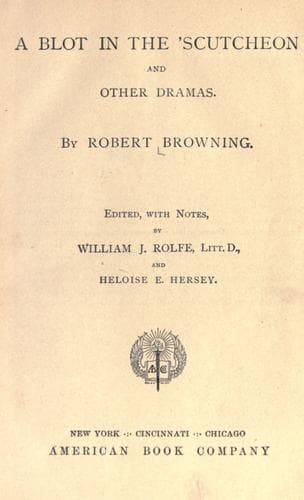
A BLOT IN THE 'SCUTCHEON
By Robert Browning
Transcriber's comments on the preparation of this e-text:
Closing brackets i.e. "]" have been added to some of the stage
directions.
Leading blanks are reproduced from the printed text. Eg.:
GUENDOLEN. Where are you taking me?
TRESHAM. He fell just here.
INTRODUCTORY NOTE
ROBERT BROWNING stands, in respect to his origin and his career, in
marked contrast to the two aristocratic poets beside whose dramas his
"Blot in the 'Scutcheon" is here printed. His father was a bank clerk
and a dissenter at a time when dissent meant exclusion from Society; the
poet went neither to one of the great public schools nor to Oxford or
Cambridge; and no breath of scandal touched his name. Born in London in
1812, he was educated largely by private tutors, and spent two years at
London University, but the influence of his father, a man of wide
reading and cultivated tastes, was probably the most important element
in his early training. He drew well, was something of a musician, and
wrote verses from an early age, though it was the accidental reading of
a volume of Shelley which first kindled his real inspiration. This
indebtedness is beautifully acknowledged in his first published poem,
"Pauline" (1833).
Apart from frequent visits to Italy, there is little of incident to
chronicle in Browning's life, with the one great exception of his more
than fortunate marriage in 1846 to Elizabeth Barrett, the greatest of
English poetesses.
Browning's dramatic period extended from 1835 to the time of his
marriage, and produced some nine plays, not all of which, however, were
intended for the stage. "Paracelsus," the first of the series, has been
fairly described as a "conversational drama," and "Pippa Passes," though
it has been staged, is essentially a poem to read. The historical
tragedy of "Strafford" has been impressively performed, but "King Victor
and King Charles," "The Return of the Druses," "Colombe's Birthday," "A
Soul's Tragedy," and "Luria," while interesting in many ways, can hardly
be regarded as successful stage-plays. "A Blot in the 'Scutcheon" was
performed at Drury Lane, but its chances of a successful run were
spoiled by the jealousy of Macready, the manager.
The main cause of Browning's weakness as a playwright lay in the fact
that he was so much more interested in psychology than in action. But in
the present tragedy this defect is less prominent than usual, and in
spite of flaws in construction, it reaches a high pitch of emotional
intensity, the characters are drawn with vividness, and the lines are
rich in poetry.
A BLOT IN THE 'SCUTCHEON
A TRAGEDY
(1843)
DRAMATIS PERSONAE
MILDRED TRESHAM.
GUENDOLEN TRESHAM.
THOROLD, Earl Tresham.
AUSTIN TRESHAM.
HENRY, Earl Mertoun.
GERARD, and other retainers of Lord Tresham.
Time, 17--
ACT I
Public-domain text, read in full here on John Shaqi.
Reviews
Reviews
No reviews yet
Be the first to share your thoughts on this work.
Join the Discussion
Join the discussion
Sign in to leave a comment or review.
Sign InorCreate an account